
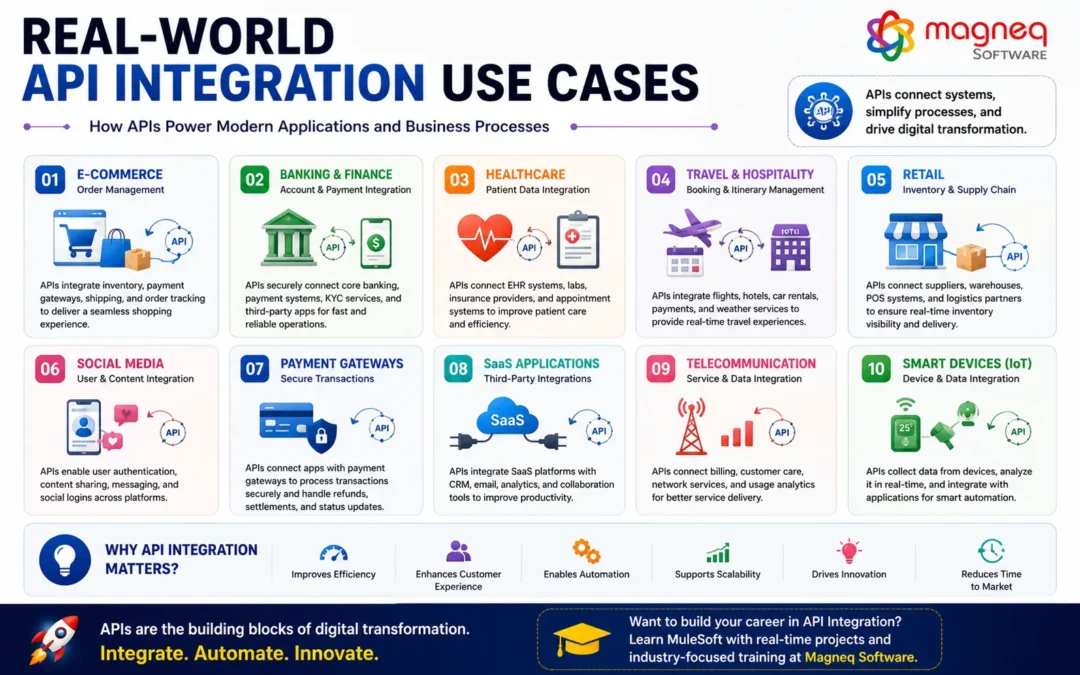
Real-World API Integration Use Cases: How APIs Are Transforming Modern Businesses in 2026
Introduction
Looking to start your career in MuleSoft? Join our Best MuleSoft Training in Hyderabad and gain hands-on experience with real-time projects, certification guidance, and placement support.
This is where Application Programming Interfaces (APIs) play a crucial role.
APIs act as digital bridges that allow different applications and systems to communicate, exchange data, and automate business processes in real time. Whether you’re ordering food online, making a digital payment, booking a flight, or tracking a shipment, APIs work behind the scenes to make these interactions seamless.
As organizations continue their digital transformation journey in 2026, API integration has become a strategic necessity rather than a technical option. In this article, we’ll explore real-world API integration use cases and understand how APIs are transforming modern businesses across industries.
What Is API Integration?
API Integration is the process of connecting different software applications and systems through APIs to enable data exchange and process automation.
Instead of manually transferring information between systems, APIs allow applications to communicate automatically and securely.
Simple Example
When a customer places an order on an e-commerce website:
- The payment gateway verifies the payment.
- The inventory system updates stock levels.
- The logistics system receives shipping information.
- The customer receives an order confirmation.
All these processes happen through API integrations.
Why API Integration Is Important in 2026
Modern organizations use multiple technologies, including:
- CRM Systems
- ERP Applications
- Cloud Platforms
- Mobile Applications
- Payment Gateways
- Marketing Tools
- Business Intelligence Systems
Without API integration, managing these systems becomes inefficient and time-consuming.
Benefits of API Integration
✅ Real-Time Data Exchange
✅ Process Automation
✅ Improved Customer Experience
✅ Increased Productivity
✅ Reduced Operational Costs
✅ Better Decision Making
✅ Enhanced Business Agility
How APIs Are Driving Digital Transformation
Digital transformation requires organizations to connect systems, streamline operations, and provide real-time services.
APIs help businesses:
- Modernize legacy systems
- Build scalable applications
- Enable cloud connectivity
- Improve collaboration
- Deliver personalized customer experiences
This is why APIs are often referred to as the backbone of digital transformation.
Real-World API Integration Use Cases
Let’s explore how different industries use APIs to improve efficiency and customer satisfaction.
1. E-Commerce and Online Retail
The e-commerce industry heavily relies on APIs to deliver seamless shopping experiences.
API Integrations Used
- Payment Gateways
- Inventory Management Systems
- Shipping Providers
- Customer Relationship Management Systems
- Product Recommendation Engines
Example
When a customer places an order:
- Payment API processes the transaction.
- Inventory API updates stock.
- Shipping API schedules delivery.
- Notification API sends confirmation emails.
Business Benefits
✔ Faster order processing
✔ Accurate inventory tracking
✔ Better customer experience
✔ Reduced manual effort
2. Banking and Financial Services
Financial institutions use APIs to provide secure and real-time financial services.
Common API Integrations
- Mobile Banking
- Payment Processing
- Fraud Detection Systems
- Credit Score Services
- Investment Platforms
Example
When a customer transfers money using a mobile banking app:
- Authentication API verifies identity.
- Banking API processes the transaction.
- Notification API sends transaction alerts.
Benefits
✔ Faster transactions
✔ Enhanced security
✔ Better customer engagement
✔ Real-time financial services
3. Healthcare Industry
Healthcare providers rely on APIs to improve patient care and operational efficiency.
Integration Examples
- Electronic Health Records (EHR)
- Appointment Scheduling
- Insurance Verification
- Laboratory Systems
- Telemedicine Platforms
Example
A patient books an appointment online:
- Scheduling API confirms availability.
- Insurance API verifies coverage.
- Notification API sends reminders.
Benefits
✔ Improved patient experience
✔ Faster service delivery
✔ Better data accessibility
✔ Enhanced healthcare coordination
4. Travel and Hospitality
Travel companies use APIs to provide real-time booking experiences.
Common Integrations
- Flight Booking Systems
- Hotel Reservation Platforms
- Payment Gateways
- Travel Insurance Providers
- Customer Loyalty Programs
Example
When a user searches for travel options:
- Airline APIs provide flight details.
- Hotel APIs return accommodation options.
- Pricing APIs calculate costs.
Benefits
✔ Real-time availability
✔ Dynamic pricing
✔ Better customer satisfaction
✔ Improved booking efficiency
5. Logistics and Supply Chain Management
Modern logistics operations depend heavily on API connectivity.
API Use Cases
- Shipment Tracking
- Warehouse Management
- Inventory Systems
- Fleet Management
- Route Optimization
Example
A customer tracks a shipment:
- GPS APIs provide location updates.
- Logistics APIs share delivery status.
- Notification APIs send alerts.
Benefits
✔ Increased visibility
✔ Improved delivery accuracy
✔ Better operational efficiency
✔ Enhanced customer communication
6. Social Media Platforms
Social media applications use APIs extensively.
Examples
- User Authentication
- Content Sharing
- Messaging Services
- Analytics Tools
- Advertising Platforms
Example
When users log into an application using social media credentials:
- Authentication APIs validate identity.
- User profile information is retrieved automatically.
Benefits
✔ Simplified login process
✔ Better user engagement
✔ Enhanced marketing opportunities
7. Payment Gateway Integration
Payment APIs are among the most widely used integrations today.
Common Features
- Credit Card Processing
- UPI Transactions
- Digital Wallets
- Subscription Payments
- Refund Management
Example
Online stores use payment APIs to securely process customer transactions in seconds.
Benefits
✔ Secure transactions
✔ Faster payment processing
✔ Global payment support
✔ Reduced payment failures
8. Human Resource Management Systems
Organizations use APIs to automate HR processes.
Integration Examples
- Recruitment Platforms
- Payroll Systems
- Attendance Management
- Employee Portals
Benefits
✔ Faster onboarding
✔ Automated payroll processing
✔ Improved employee management
✔ Reduced administrative workload
9. Internet of Things (IoT)
IoT devices generate large volumes of data that require real-time processing.
Examples
- Smart Homes
- Industrial Sensors
- Connected Vehicles
- Healthcare Wearables
How APIs Help
APIs enable devices to communicate with cloud platforms and analytics systems.
Benefits
✔ Real-time monitoring
✔ Predictive maintenance
✔ Better decision making
✔ Increased automation
10. Artificial Intelligence and Machine Learning
AI systems rely on APIs to access and process data.
Common Use Cases
- AI Chatbots
- Recommendation Engines
- Predictive Analytics
- Voice Assistants
Example
An AI chatbot uses APIs to retrieve customer information and provide personalized responses.
Benefits
✔ Faster customer support
✔ Improved personalization
✔ Better business insights
The Role of MuleSoft in API Integration
As organizations adopt hundreds of applications and services, managing integrations becomes increasingly complex.
This is where MuleSoft provides immense value.
MuleSoft Enables
- API Design and Development
- API Management
- Data Transformation
- Cloud Integration
- Real-Time Connectivity
Using MuleSoft’s Anypoint Platform, organizations can create scalable, secure, and reusable APIs that simplify enterprise integration.
Future Trends in API Integration for 2026
Several trends are shaping the future of API integration:
AI-Powered APIs
Artificial Intelligence is making APIs smarter and more intelligent.
Event-Driven Architecture
Real-time event processing is becoming standard.
Multi-Cloud Integration
Organizations need seamless connectivity across multiple cloud environments.
API Security Enhancements
Security remains a top priority as API usage increases.
Low-Code Integration Platforms
Businesses want faster and easier integration development.
Hyperautomation
Combining APIs, AI, and automation technologies will drive future innovation.
Career Opportunities in API Integration
As API adoption grows, companies are actively hiring professionals with integration skills.
Popular Job Roles
- MuleSoft Developer
- API Developer
- Integration Engineer
- Middleware Consultant
- Solutions Architect
- Cloud Integration Specialist
Skills in Demand
- MuleSoft
- REST APIs
- SOAP APIs
- DataWeave
- Cloud Computing
- API Security
Professionals with API integration expertise are among the most sought-after candidates in the IT industry.
Why Learning API Integration Is a Smart Career Move
API integration sits at the center of digital transformation initiatives.
By learning API technologies and platforms like MuleSoft, professionals can:
✔ Access high-demand job opportunities
✔ Build future-proof skills
✔ Work on enterprise-level projects
✔ Increase earning potential
✔ Contribute to innovative business solutions
As organizations continue investing in connected ecosystems, API integration skills will remain valuable for years to come.
Conclusion
APIs have transformed the way modern businesses operate by enabling seamless communication between applications, systems, and services. From banking and healthcare to e-commerce and logistics, API integrations drive automation, efficiency, and innovation across industries.
As digital transformation accelerates in 2026, API integration will continue to play a critical role in helping organizations deliver exceptional customer experiences and achieve operational excellence.
For aspiring IT professionals, learning API integration and MuleSoft can open doors to exciting career opportunities in one of the fastest-growing technology domains.