
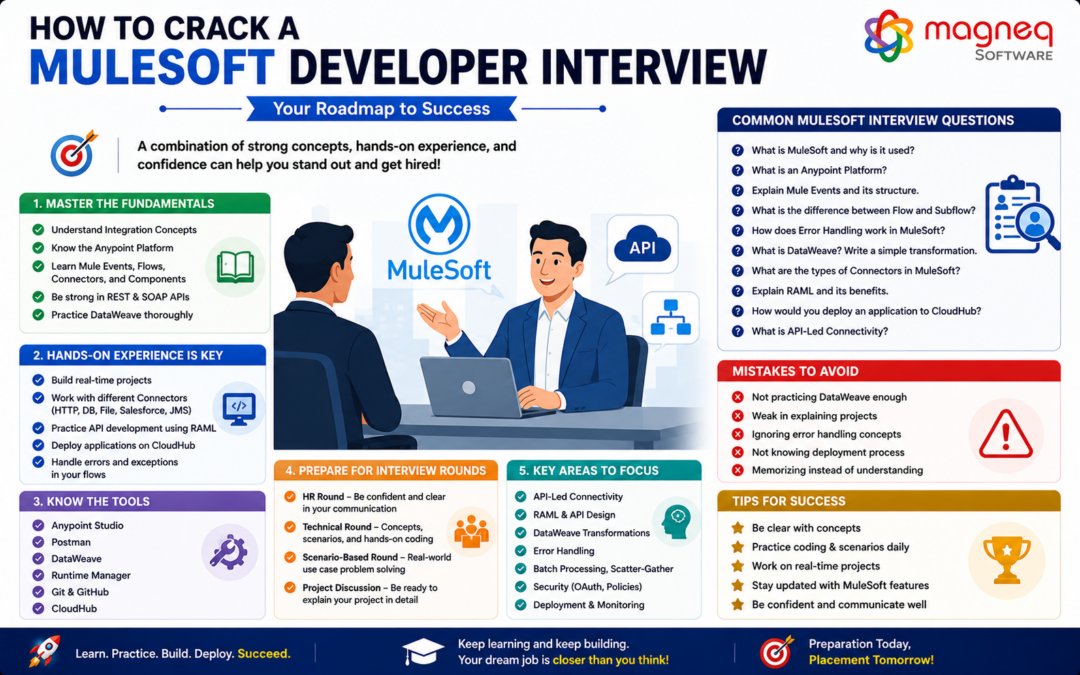
How to Crack a MuleSoft Developer Interview: Complete Preparation Guide for Freshers and Experienced Professionals
Introduction
As businesses continue their digital transformation journey, the demand for skilled MuleSoft Developers is growing rapidly. Organizations across industries such as Banking, Healthcare, Retail, Insurance, Telecommunications, and Manufacturing are actively hiring professionals who can design APIs, integrate applications, and build scalable enterprise solutions.
MuleSoft has become one of the leading integration platforms worldwide, making it an excellent career choice for both freshers and experienced IT professionals. However, securing a MuleSoft Developer role requires more than just theoretical knowledge. Recruiters look for candidates who understand API-led connectivity, DataWeave, integration patterns, error handling, and real-world project implementation.
This comprehensive guide will help you understand the MuleSoft interview process, key technical concepts to focus on, commonly asked interview questions, and proven strategies to crack MuleSoft interviews in 2026.
Why MuleSoft Developers Are in High Demand
Modern enterprises use multiple applications, cloud platforms, databases, and third-party services. Connecting these systems efficiently is critical for business success.
MuleSoft helps organizations:
- Connect applications and systems
- Develop and manage APIs
- Automate business workflows
- Integrate cloud and on-premise applications
- Enable digital transformation
As a result, MuleSoft professionals are among the most sought-after IT specialists in today’s job market.
Understanding the MuleSoft Interview Process
Most companies follow a structured interview process.
Round 1: Resume Screening
Recruiters evaluate:
- MuleSoft knowledge
- API development skills
- Project experience
- Certifications
- Technical background
Pro Tip
Highlight:
✔ Real-time projects
✔ API development experience
✔ MuleSoft certifications
✔ Integration use cases
A strong resume increases your chances of receiving interview calls.
Round 2: Technical Assessment
Some organizations conduct online assessments covering:
- MuleSoft fundamentals
- API concepts
- DataWeave
- Integration scenarios
- Logical reasoning
Preparation Tip
Practice creating APIs and solving DataWeave transformation problems regularly.
Round 3: Technical Interview
This is the most critical stage.
Interviewers assess:
- Technical knowledge
- Problem-solving ability
- Integration design skills
- Project experience
- Practical understanding
Round 4: Managerial Round
Topics include:
- Team collaboration
- Project contributions
- Problem-solving approaches
- Communication skills
Round 5: HR Discussion
This round focuses on:
- Salary expectations
- Notice period
- Relocation preferences
- Career goals
Core Topics You Must Prepare
1. MuleSoft Fundamentals
Every interview begins with basic concepts.
Important Topics
- What is MuleSoft?
- Anypoint Platform
- Mule Events
- Payloads
- Variables
- Flows
- Subflows
- Message Processors
Frequently Asked Questions
What is MuleSoft?
MuleSoft is an integration platform that enables organizations to connect applications, data, and devices using APIs and integrations.
What is Anypoint Platform?
Anypoint Platform is MuleSoft’s unified platform for API development, integration, deployment, monitoring, and management.
What is a Mule Event?
A Mule Event is the data structure that travels through a Mule application and contains payload, variables, and attributes.
2. API Concepts
APIs form the foundation of MuleSoft development.
Topics to Master
- REST APIs
- SOAP APIs
- HTTP Methods
- HTTP Status Codes
- API Security
- API Lifecycle
Common Interview Questions
What is an API?
An API enables communication between software applications.
Difference Between REST and SOAP?
| REST | SOAP |
|---|---|
| Lightweight | Protocol-based |
| Uses JSON | Uses XML |
| Faster | Slower |
| Flexible | More Structured |
What Are HTTP Methods?
- GET
- POST
- PUT
- DELETE
- PATCH
Interviewers frequently ask practical API-related questions.
3. API-Led Connectivity
This is one of MuleSoft’s most important concepts.
Three Layers
System APIs
Connect backend systems.
Process APIs
Implement business logic.
Experience APIs
Provide data to specific consumers.
Sample Question
What are the advantages of API-Led Connectivity?
Expected Answer:
- Reusability
- Scalability
- Faster development
- Better maintenance
4. DataWeave Preparation
DataWeave is one of the most frequently tested topics.
Topics to Learn
- Variables
- Operators
- Functions
- Transformations
- Conditional Statements
- Filtering Data
Common Questions
What is DataWeave?
DataWeave is MuleSoft’s data transformation language used to convert and manipulate data.
Example Transformations
- JSON to XML
- XML to JSON
- CSV to JSON
Interview Tip
Practice transformation scenarios daily.
5. Connectors and Integration
Connectors enable communication with external systems.
Must-Know Connectors
- HTTP Connector
- Database Connector
- File Connector
- FTP Connector
- Salesforce Connector
- JMS Connector
Common Questions
What is a Connector?
A Connector allows MuleSoft applications to interact with external systems.
What is HTTP Listener?
HTTP Listener receives incoming requests and triggers Mule flows.
6. Error Handling
Error handling is a favorite interview topic.
Concepts to Prepare
- Try Scope
- On Error Continue
- On Error Propagate
- Global Error Handler
Frequently Asked Questions
What is On Error Continue?
Handles errors and allows flow execution to continue.
What is On Error Propagate?
Handles the error and propagates it to the caller.
Scenario-Based Question
How would you handle database connection failures?
Expected Answer:
- Implement error handling
- Log exceptions
- Retry logic if required
- Return meaningful responses
7. RAML and API Design
API design knowledge is highly valuable.
Topics
- RAML
- Resources
- Methods
- Traits
- Data Types
Common Questions
What is RAML?
RAML (RESTful API Modeling Language) is used to design and document APIs.
Benefits of RAML
- Better API documentation
- Standardized design
- Faster development
8. Deployment and CloudHub
Many candidates overlook deployment concepts.
Topics to Learn
- CloudHub
- Runtime Manager
- Deployment Strategies
- Monitoring
- Logging
Frequently Asked Questions
What is CloudHub?
CloudHub is MuleSoft’s cloud-based deployment platform.
What is Runtime Manager?
Runtime Manager is used to deploy, monitor, and manage Mule applications.
Advanced Topics for Experienced Professionals
Experienced candidates should also prepare:
Batch Processing
Used for processing large datasets efficiently.
Scatter-Gather
Allows parallel execution of multiple requests.
Choice Router
Implements conditional logic.
Object Store
Stores temporary application data.
Transactions
Ensures reliable processing across systems.
Real-Time Project Preparation
Many interviewers spend significant time discussing projects.
Be Ready to Explain
- Project overview
- Business requirements
- Architecture
- Challenges faced
- Solutions implemented
- Technologies used
Popular MuleSoft Projects
Banking Integration
Integrating accounts, transactions, and payment systems.
E-Commerce Integration
Connecting inventory, payments, and shipping providers.
Salesforce Integration
Synchronizing customer data across platforms.
Healthcare Integration
Connecting patient records and appointment systems.
Scenario-Based Interview Questions
Modern interviews focus heavily on practical scenarios.
Question 1
How would you integrate multiple systems with different data formats?
Expected Answer:
Use DataWeave transformations and reusable APIs.
Question 2
How would you call multiple APIs simultaneously?
Expected Answer:
Use Scatter-Gather component.
Question 3
How would you secure an API?
Expected Answer:
- OAuth 2.0
- Client ID Enforcement
- JWT Authentication
- API Policies
Top MuleSoft Interview Questions
Beginner Level
- What is MuleSoft?
- What is Anypoint Platform?
- What is a Mule Event?
- What is Payload?
- What are Variables?
- Difference between Flow and Subflow?
- What is DataWeave?
- What is API-Led Connectivity?
- What are Connectors?
- What is CloudHub?
Intermediate Level
- Explain Error Handling.
- What is RAML?
- Explain DataWeave Functions.
- What is HTTP Listener?
- What is Runtime Manager?
Advanced Level
- What is Batch Processing?
- What is Scatter-Gather?
- What is Object Store?
- Explain Transactions.
- How do you secure APIs?
Common Mistakes Candidates Make
❌ Memorizing answers without understanding concepts
❌ Weak API knowledge
❌ Ignoring DataWeave practice
❌ Poor project explanations
❌ Lack of deployment knowledge
❌ Insufficient hands-on experience
Avoiding these mistakes can significantly improve interview performance.
Tips to Crack MuleSoft Interviews Successfully
Focus on Hands-On Practice
Build APIs and integrations regularly.
Work on Real-Time Projects
Projects demonstrate practical expertise.
Strengthen API Fundamentals
Strong API knowledge is essential.
Practice DataWeave Daily
DataWeave questions appear in almost every interview.
Prepare Scenario-Based Answers
Interviewers increasingly focus on real-world problem-solving.
Improve Communication Skills
Technical knowledge combined with effective communication creates a strong impression.
MuleSoft Certifications That Can Help
Recommended Certifications
- MuleSoft Certified Developer Level 1 (MCD Level 1)
- MuleSoft Certified Platform Architect
- MuleSoft Certified Integration Architect
Certifications validate your expertise and improve job prospects.
Career Growth After Becoming a MuleSoft Developer
A typical career path includes:
MuleSoft Developer → Senior MuleSoft Developer → Integration Lead → MuleSoft Architect → Integration Consultant
With experience, professionals can work on enterprise-level projects and earn highly competitive salaries.
Conclusion
Cracking a MuleSoft Developer interview requires a strong understanding of integration fundamentals, APIs, DataWeave, connectors, deployment concepts, and real-world project experience. Whether you’re a fresher entering the job market or an experienced professional looking for career growth, consistent practice and hands-on learning are the keys to success.
Focus on building practical projects, mastering API-led connectivity, improving DataWeave skills, and preparing for scenario-based questions. With the right preparation strategy, you can confidently clear MuleSoft interviews and build a successful career in one of the fastest-growing areas of enterprise
Join the Best MuleSoft Training in Hyderabad with real-time projects, certification guidance, expert trainers, and placement assistance. Book a free demo today.