
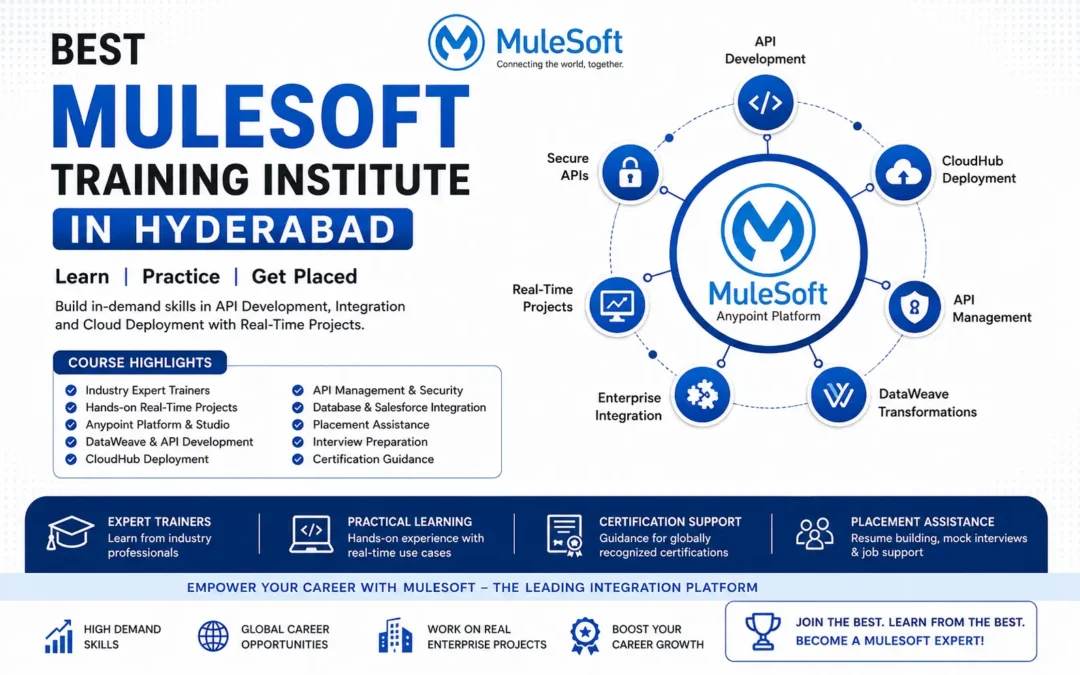
Best MuleSoft Training Institute in Hyderabad
Introduction
Imagine running a business where your website, payment gateway, CRM, ERP software, mobile application, and cloud storage all work together effortlessly. No manual data entry, no delays, and no communication gaps between systems. That seamless experience is exactly what MuleSoft helps organizations achieve.
Today, companies use dozens of applications to manage different business operations. Sales teams use CRM software, finance departments work with ERP systems, HR relies on employee management platforms, and customers interact through websites and mobile apps. Without proper integration, these systems become isolated, making data sharing slow and inefficient.
This is why MuleSoft has become one of the world’s leading enterprise integration platforms. It enables businesses to connect applications, automate workflows, manage APIs, and accelerate digital transformation.
If you’re planning to build a career in enterprise integration, cloud technologies, or API development, learning MuleSoft is an excellent investment. Enrolling in the best MuleSoft training institute in Hyderabad can provide practical skills, real-time project experience, and placement support to help you succeed in today’s competitive IT industry.
Table of Contents
| Sr# | Headings |
|---|---|
| 1 | What is MuleSoft Technology? |
| 2 | Understanding API-Led Connectivity |
| 3 | Why Businesses Choose MuleSoft |
| 4 | Features of MuleSoft |
| 5 | Components of Anypoint Platform |
| 6 | Industries Using MuleSoft |
| 7 | Benefits of Learning MuleSoft |
| 8 | Career Opportunities |
| 9 | Why Choose the Best MuleSoft Training Institute in Hyderabad |
| 10 | Real-Time Projects |
| 11 | Future of MuleSoft |
| 12 | Conclusion |
| 13 | FAQs |
What is MuleSoft Technology?
MuleSoft is an enterprise integration platform that enables businesses to connect different applications, databases, cloud services, devices, and software systems using Application Programming Interfaces (APIs).
Think of MuleSoft as a bridge connecting different islands. Each island represents a business application such as Salesforce, SAP, Oracle, AWS, Microsoft Azure, or a payment gateway. Without a bridge, people cannot easily travel between islands. Similarly, without MuleSoft, software applications struggle to exchange information efficiently.
MuleSoft solves this challenge by providing the Anypoint Platform, a unified environment where developers can design, develop, deploy, monitor, and manage APIs. Rather than building separate integrations for every application, developers create reusable APIs that simplify communication across multiple systems.
This approach reduces development time, lowers maintenance costs, improves scalability, and helps organizations respond faster to changing business needs.
Understanding API-Led Connectivity
One of MuleSoft’s biggest strengths is its API-led connectivity architecture. Traditional integrations often involve creating direct connections between applications. As more systems are added, these point-to-point integrations become increasingly difficult to manage.
MuleSoft organizes integrations into three reusable API layers:
System APIs
These APIs connect directly with databases, ERP software, CRM applications, and legacy systems. They provide secure access to business data while hiding underlying complexity.
Process APIs
Process APIs combine information from multiple systems, apply business logic, and transform data into formats required by different applications.
Experience APIs
These APIs deliver customized information to websites, mobile apps, customer portals, and partner applications, ensuring users receive the data they need in an optimized format.
This layered architecture makes enterprise integration more flexible, scalable, and easier to maintain, which is why organizations around the world prefer MuleSoft for large-scale integration projects.
Why Businesses Choose MuleSoft
Modern businesses rely on a wide range of software solutions to manage operations. Without effective integration, departments work in isolation, leading to duplicated efforts, inconsistent data, and slower decision-making.
MuleSoft addresses these challenges by enabling organizations to:
-
Connect cloud and on-premises applications
-
Automate repetitive business processes
-
Build secure and reusable APIs
-
Synchronize data in real time
-
Improve customer experiences
-
Accelerate digital transformation initiatives
Organizations across banking, healthcare, retail, insurance, manufacturing, telecommunications, logistics, education, and government sectors use MuleSoft to streamline operations and improve productivity.
Another major advantage is that MuleSoft supports integrations with popular enterprise platforms such as Salesforce, SAP, Oracle, AWS, Microsoft Azure, Workday, ServiceNow, and many others. This flexibility makes it one of the most powerful integration platforms available today.
Key Features of MuleSoft
MuleSoft offers several features that simplify enterprise integration and API management.
Anypoint Platform
A centralized platform for designing, developing, deploying, monitoring, and managing APIs.
DataWeave
A powerful transformation language used to convert data between JSON, XML, CSV, Java objects, and other formats.
CloudHub
A cloud-based deployment platform that enables developers to deploy and manage Mule applications securely.
API Manager
Provides tools for API security, monitoring, policy management, analytics, and governance.
Exchange
A reusable repository where organizations store APIs, connectors, templates, and integration assets.
Runtime Manager
Helps developers deploy, monitor, and manage Mule applications running across cloud and on-premises environments.
Together, these components enable organizations to build scalable, secure, and reusable enterprise integration solutions.
Components of the MuleSoft Anypoint Platform
The Anypoint Platform includes several powerful tools that simplify enterprise integration.
Anypoint Studio provides a visual development environment for building Mule applications.
API Designer allows developers to design APIs using RAML and OpenAPI specifications.
API Manager secures APIs through authentication, authorization, rate limiting, and policy enforcement.
CloudHub simplifies cloud deployment and application monitoring.
DataWeave enables complex data transformations using concise scripts.
Exchange encourages API reuse by storing templates, connectors, and documentation in a centralized repository.
Understanding these tools is essential for anyone planning to become a professional MuleSoft Developer.