
What is DevOps? DevOps Meaning, Explained and What Does DevOps Do?
In today’s fast-moving technology industry, businesses need to develop, test, and release software faster than ever. At the same time, applications must be reliable, secure, scalable, and available to users without interruption. This is where DevOps plays an important role.
But what is DevOps, and why has it become such an important skill for IT professionals?
In simple terms, DevOps is a combination of development (Dev) and operations (Ops). It is a set of practices, tools, processes, and cultural principles that help development and IT operations teams work together to deliver software faster and more efficiently.
In this blog, we will understand the DevOps meaning, get DevOps explained in simple terms, and answer the important question: what does DevOps do?
What is DevOps?
DevOps is a software development approach that brings development and operations teams together to automate and improve the software development and delivery process.
Traditionally, developers were responsible for writing application code, while operations teams were responsible for deploying, managing, and maintaining applications. Because these teams often worked separately, software releases could take longer and communication problems could occur.
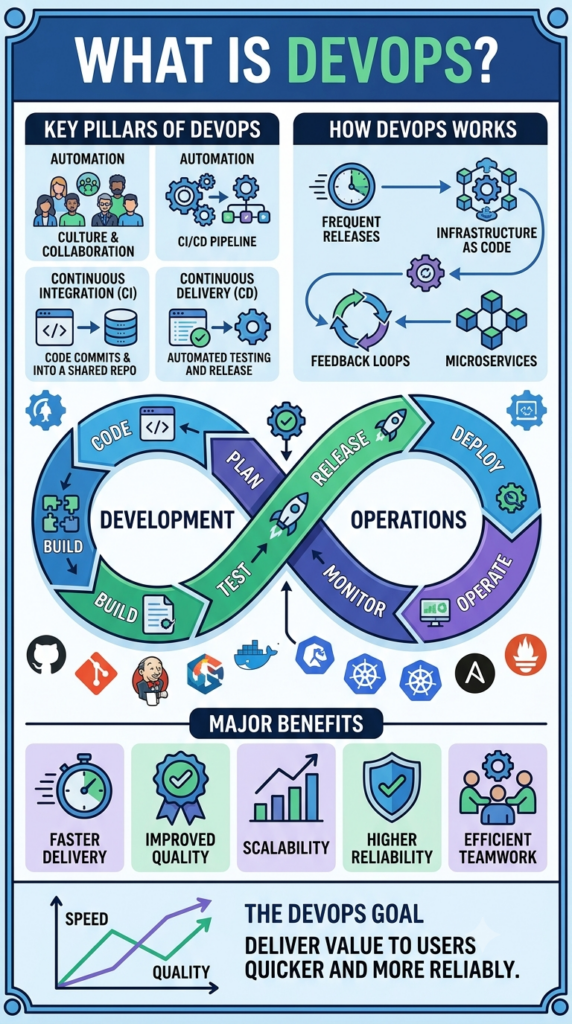
DevOps helps remove these barriers by encouraging collaboration, automation, continuous testing, continuous integration, continuous delivery, monitoring, and faster feedback.
The main goal of DevOps is not simply to use a particular tool. Instead, it focuses on improving the complete software delivery lifecycle.
DevOps Meaning
The DevOps meaning can be understood by looking at the two words:
- Dev – Software Development
- Ops – IT Operations
Together, DevOps represents collaboration between development and operations.
However, modern DevOps goes beyond simply combining two departments. It involves practices that allow teams to plan, develop, test, deploy, monitor, and improve applications continuously.
For example, instead of waiting several months to release a new application version, a DevOps team may automate many parts of the process and release smaller changes more frequently.
This can help organizations respond more quickly to customer requirements and business changes.
DevOps Explained in Simple Terms
Let’s understand DevOps explained through a simple example.
Imagine a software company is developing an online shopping application.
The development team writes the code for features such as:
- User registration
- Product search
- Shopping cart
- Online payments
- Order tracking
Once developers complete the code, it needs to be tested and deployed to servers.
In a traditional environment, developers may send the completed code to the operations team. Operations then manually deploys the application. If something goes wrong, the issue may go back to developers, creating delays.
With DevOps, development and operations teams work more closely together. Many repetitive activities can be automated using DevOps tools.
A typical process may look like:
Plan → Code → Build → Test → Release → Deploy → Operate → Monitor
This cycle can continue repeatedly, allowing teams to deliver improvements more frequently.
What Does DevOps Do?
One common question beginners ask is, what does DevOps do?
DevOps helps organizations improve the way software is developed, tested, released, deployed, and maintained.
A DevOps professional may work on activities such as:
1. Automation
DevOps engineers automate repetitive tasks such as building applications, running tests, deploying code, and managing infrastructure.
Automation reduces manual effort and can make software delivery more consistent.
2. Continuous Integration
Continuous Integration, or CI, allows developers to regularly integrate their code into a shared repository.
Automated builds and tests can then identify problems early in the development process.
3. Continuous Delivery and Deployment
DevOps practices can help organizations automate the process of moving tested software toward production.
Continuous Delivery focuses on keeping software ready for release, while Continuous Deployment can automatically release qualifying changes to production.
4. Infrastructure Management
DevOps teams may use tools and practices to provision and manage infrastructure efficiently.
Infrastructure as Code, or IaC, allows infrastructure configurations to be managed through code and version control.
5. Monitoring
After an application is deployed, teams need to know whether it is working correctly.
DevOps teams use monitoring and logging tools to track application performance, infrastructure health, errors, and other important metrics.
6. Collaboration
DevOps encourages developers, testers, system administrators, security teams, and other stakeholders to collaborate throughout the software lifecycle.
This can reduce communication gaps and improve overall delivery.
Important DevOps Tools
DevOps is not a single technology. It involves a collection of tools that can be used at different stages of the software lifecycle.
Some commonly used DevOps tools and technologies include:
- Git – Version control
- GitHub/GitLab – Code collaboration and repositories
- Jenkins – CI/CD automation
- Docker – Containerization
- Kubernetes – Container orchestration
- Ansible – Configuration management and automation
- Terraform – Infrastructure as Code
- AWS/Azure/GCP – Cloud platforms
- Prometheus/Grafana – Monitoring and visualization
The exact tools used depend on an organization’s technology stack and requirements.
Why is DevOps Important?
DevOps has become important because businesses need to deliver software quickly while maintaining quality and reliability.
Some potential benefits include:
Faster Software Delivery
Automation and streamlined processes can reduce the time required to move software from development to production.
Improved Collaboration
Development and operations teams work toward shared goals instead of operating as completely separate teams.
Better Reliability
Automated testing, deployment processes, monitoring, and standardization can help reduce certain types of human errors.
Faster Problem Detection
Monitoring and automated testing can help teams identify problems earlier.
Scalability
Cloud platforms, containers, automation, and Infrastructure as Code can make it easier to manage applications as business requirements change.
DevOps and Cloud Computing
DevOps and cloud computing are closely connected, although they are not the same thing.
Cloud computing provides computing resources such as servers, storage, databases, and networking through cloud platforms.
DevOps provides practices and processes for developing, deploying, operating, and improving applications.
For example, an organization may use AWS for its cloud infrastructure and Docker, Jenkins, and Terraform as part of its DevOps workflow.
This combination can help teams automate infrastructure and application delivery.
Is DevOps a Good Career Option?
DevOps has become an important area within modern software engineering and IT operations.
People entering DevOps commonly learn areas such as:
- Linux fundamentals
- Networking basics
- Git and version control
- CI/CD concepts
- Docker and containers
- Kubernetes
- Cloud computing
- Infrastructure as Code
- Monitoring and logging
- Security and DevSecOps concepts
A person does not necessarily need to master every DevOps tool at the beginning. Building strong fundamentals and learning tools progressively is generally more practical.
Training organizations such as Magneq Software can help learners understand DevOps concepts through structured learning, practical exercises, and industry-oriented training.
Final Thoughts
So, what is DevOps?
DevOps is a combination of practices, culture, collaboration, and automation designed to improve the software development and delivery lifecycle.
Understanding the DevOps meaning is only the first step. To become familiar with DevOps, learners should understand how development, testing, deployment, infrastructure, cloud computing, monitoring, and automation work together.
When DevOps is explained simply, its core idea is clear: help teams build, test, release, and operate software more efficiently through collaboration and automation.
If you are planning to build a career in DevOps, start with the fundamentals and gradually progress toward tools such as Git, Jenkins, Docker, Kubernetes, cloud platforms, and Infrastructure as Code.
With the right learning path and hands-on practice, DevOps can become a valuable skill for professionals looking to grow in the modern IT industry.