As businesses increasingly depend on cloud applications, APIs, databases, and digital platforms, connecting different systems has become an important requirement for modern organizations. MuleSoft Training helps IT professionals understand how to integrate applications, data, and devices using MuleSoft’s integration technologies.
MuleSoft is widely associated with API-led connectivity, application integration, and the Anypoint Platform. Professionals who learn MuleSoft can work on integration projects where multiple applications need to communicate securely and efficiently.
If you are looking for a career-oriented MuleSoft Training program, understanding the technology, tools, skills, and career opportunities is an important first step.
What is MuleSoft?
MuleSoft is an integration platform that helps organizations connect applications, systems, APIs, and data. It provides technologies for building, managing, deploying, and monitoring integrations.
MuleSoft’s Anypoint Platform provides tools that support the API lifecycle and application integration process.
For example, a company may have:
- A customer relationship management system
- An ERP application
- A payment gateway
- A website
- A mobile application
- Cloud-based applications
- Multiple databases
These systems may need to exchange information. MuleSoft can help developers create integrations that allow these different systems to communicate.
This is one reason why MuleSoft Training is becoming relevant for professionals interested in integration and API development.
Why is MuleSoft Important?
Modern organizations rarely depend on a single application. They use a combination of legacy systems, cloud applications, SaaS platforms, databases, and custom applications.
Connecting these systems manually can create complexity. MuleSoft provides an integration approach that can help organizations build reusable APIs and integration services.
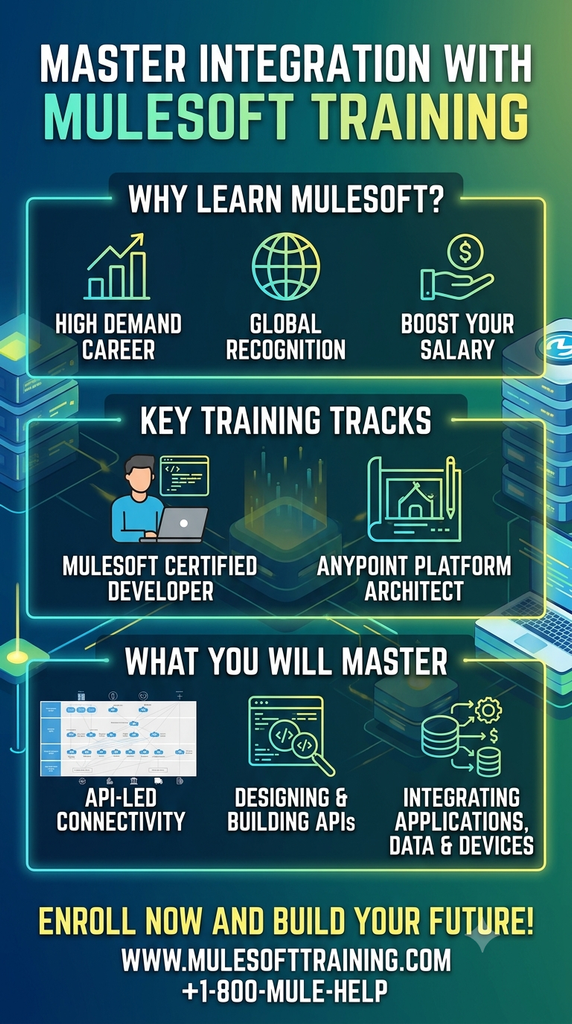
With the right MuleSoft Training, learners can understand how applications communicate and how APIs can be designed, developed, tested, secured, and managed.
MuleSoft is particularly relevant to organizations working with digital transformation, cloud migration, application modernization, and enterprise integration.
What Will You Learn in MuleSoft Training?
A structured MuleSoft Training program should cover both fundamental concepts and practical implementation.
Important topics generally include:
1. MuleSoft Fundamentals
Beginners should first understand MuleSoft architecture, integration concepts, APIs, applications, and the Anypoint Platform.
Understanding these fundamentals makes it easier to progress toward advanced integration concepts.
2. Anypoint Platform
The Anypoint Platform provides capabilities for designing, developing, managing, and monitoring APIs and integrations.
Learners should become familiar with the major components and understand how they fit into an integration lifecycle.
3. Anypoint Studio
Anypoint Studio is a development environment used for building Mule applications.
Practical MuleSoft Training should include hands-on exercises in creating flows, configuring connectors, handling data, and testing applications.
4. Mule Flows
Mule applications use flows to process and transform information.
Learners can practice creating flows that receive a request, process data, communicate with another system, and return a response.
5. Data Transformation
Data often exists in different formats. MuleSoft provides tools for transforming data between formats such as JSON, XML, CSV, and other structures.
DataWeave is an important technology for transformation and should be included in a comprehensive MuleSoft Training curriculum.
6. API Development
APIs allow applications to communicate with each other.
A good MuleSoft Training program should explain API design, API implementation, API testing, API security, and API management.
7. Connectors
MuleSoft provides connectors that can help applications communicate with different systems and services.
Learners should understand how connectors are configured and used in real-world integration scenarios.
What is API-Led Connectivity?
One of the important concepts covered in MuleSoft Training is API-led connectivity.
API-led connectivity is an approach for connecting applications and systems through reusable APIs.
It commonly involves three layers:
System APIs → Process APIs → Experience APIs
System APIs can expose data and functionality from underlying systems. Process APIs can combine and process information from different sources, while Experience APIs can deliver information for particular channels or applications.
Understanding this architecture is useful for professionals working on enterprise integration projects.
Who Can Learn MuleSoft?
MuleSoft can be relevant to a variety of IT professionals.
You may consider MuleSoft Training if you are:
- A software developer
- A Java developer
- An integration developer
- An API developer
- A middleware professional
- A cloud professional
- A testing professional interested in APIs
- An IT professional looking to move into integration
A programming background can be helpful, particularly for understanding application logic and integration development. However, beginners can start by learning the fundamentals step by step.
Career Opportunities After MuleSoft Training
Organizations need professionals who can integrate applications and build API-based solutions.
Depending on your previous experience and skills, completing MuleSoft Training can help you prepare for roles such as:
- MuleSoft Developer
- MuleSoft Integration Developer
- API Developer
- Integration Engineer
- MuleSoft Consultant
- Application Integration Engineer
Career progression depends on technical skills, project experience, communication abilities, and understanding of enterprise integration.
Hands-on projects are particularly valuable because integration concepts become easier to understand when learners work with realistic business scenarios.
Why Choose Practical MuleSoft Training?
Learning theoretical concepts alone may not be enough to become comfortable with integration technologies.
A practical MuleSoft Training approach should include:
- Instructor-led learning
- Real-world integration scenarios
- API development exercises
- DataWeave practice
- Anypoint Studio projects
- API testing
- Error handling
- Security concepts
- Deployment concepts
- Interview preparation
At Magneq Software, learners can focus on understanding MuleSoft concepts while developing practical skills that can be applied to real-world integration scenarios.
The objective should be to move beyond memorizing terminology and understand how MuleSoft is used to solve business integration problems.
MuleSoft Certification
Certification can be useful for professionals who want to validate their MuleSoft knowledge.
Before preparing for a certification examination, learners should understand the fundamentals of APIs, integration, Anypoint Platform, Mule applications, DataWeave, and deployment concepts.
Combining certification preparation with practical MuleSoft Training and project experience can provide a more complete learning approach.
How to Start Learning MuleSoft
If you are completely new to MuleSoft, follow a structured learning path:
Step 1: Understand APIs and web services.
Step 2: Learn MuleSoft fundamentals.
Step 3: Explore Anypoint Platform.
Step 4: Practice Anypoint Studio.
Step 5: Learn Mule flows and connectors.
Step 6: Learn DataWeave and data transformation.
Step 7: Build APIs and integration applications.
Step 8: Learn API management and security.
Step 9: Work on real-world projects.
Step 10: Prepare for interviews and certification.
This structured approach can make MuleSoft Training easier for beginners and professionals transitioning into integration roles.
Final Thoughts
MuleSoft has an important role in modern application integration and API-led connectivity. As businesses continue adopting cloud applications and digital platforms, the ability to connect different systems remains an important technical requirement.
The right MuleSoft Training can help learners build knowledge of APIs, Anypoint Platform, Anypoint Studio, DataWeave, connectors, integration patterns, and API management.
If you are planning to develop a career in enterprise integration, start with the fundamentals, practice consistently, and work on real-world projects.
Magneq Software can help learners build a structured understanding of MuleSoft through concept-based learning and practical training designed around industry-relevant integration scenarios.