
Best Mulesoft Training in Hyderabad
Introduction to Best MuleSoft Training in Hyderabad
Modern businesses use multiple applications every day. Companies work with CRM software, databases, cloud platforms, mobile applications, ERP systems, payment gateways, and third-party APIs.
The biggest challenge is making all these systems communicate with each other smoothly.
This is where MuleSoft becomes important.
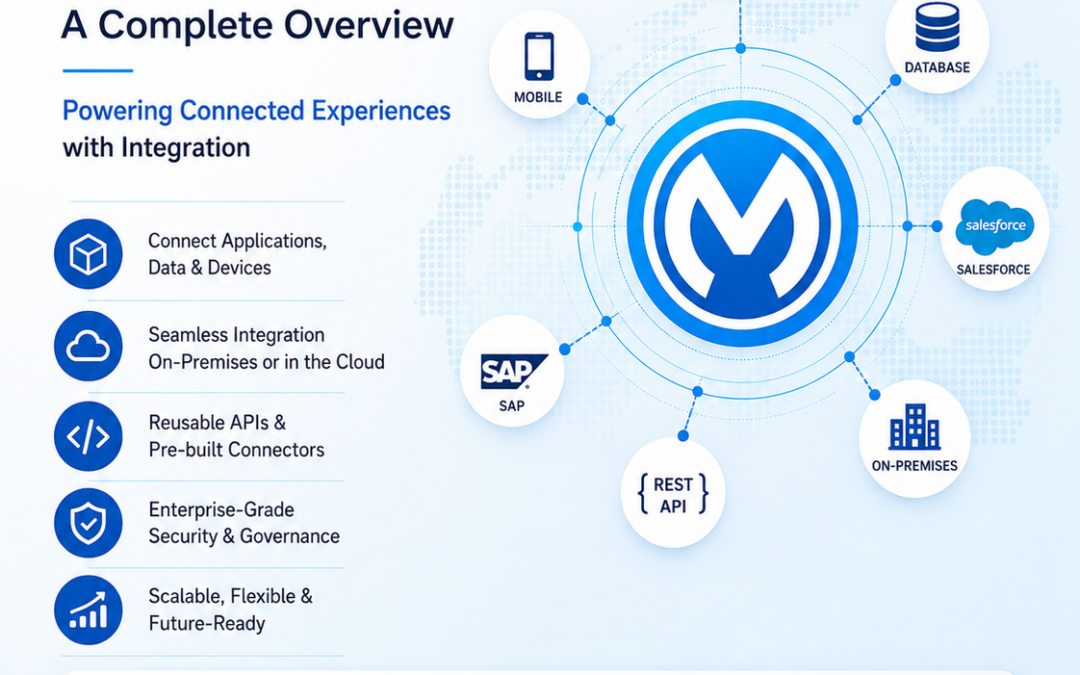
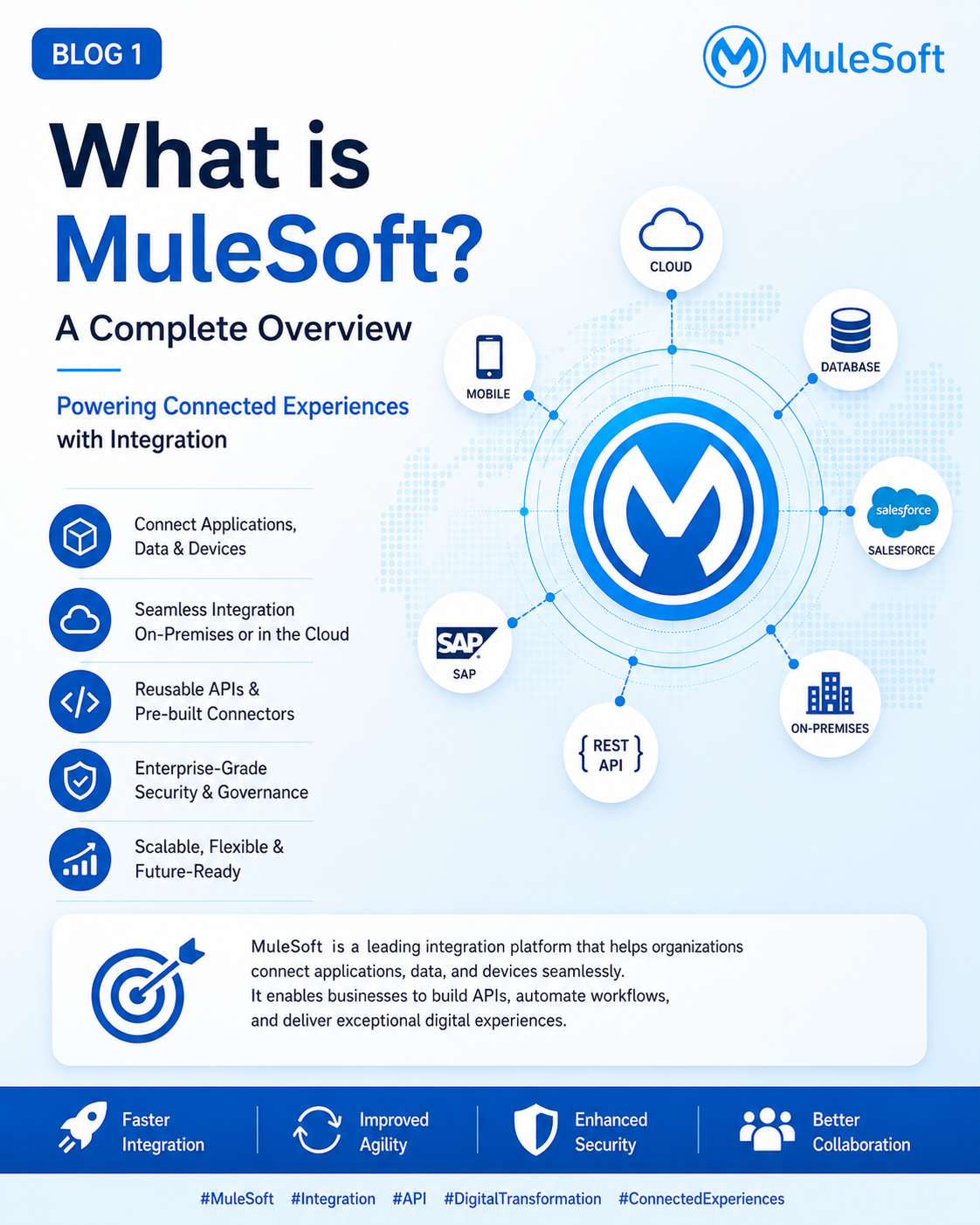
Best MuleSoft Training in Hyderabad is one of the world’s leading integration platforms that helps businesses connect applications, data, and devices using APIs. It simplifies integration and allows organizations to build scalable digital ecosystems.
Today, many global companies use MuleSoft for:
- Application Integration
- Cloud Integration
- API Management
- Data Synchronization
- Enterprise Automation
- Digital Transformation
Because of its growing demand, MuleSoft has become one of the most valuable skills in the IT industry.
What is MuleSoft?
MuleSoft is an enterprise integration platform that enables organizations to connect applications, systems, and data sources through APIs.
It provides a unified platform called the Anypoint Platform, which helps developers design, build, deploy, manage, and monitor APIs and integrations.
The core idea behind MuleSoft is simple:
“Connect anything, anywhere.”
Using MuleSoft, businesses can connect:
- Cloud Applications
- Legacy Systems
- Databases
- SaaS Applications
- Mobile Apps
- IoT Devices
- External APIs
without creating complicated point-to-point integrations.
History of MuleSoft
MuleSoft was founded in 2006 with the goal of simplifying enterprise integration.
Initially, it started as an open-source integration framework called Mule ESB (Enterprise Service Bus).
Later, MuleSoft expanded its capabilities into:
- API Management
- Cloud Integration
- Hybrid Integration
- Microservices Connectivity
- Automation
In 2018, Salesforce acquired MuleSoft, which significantly increased its global adoption.
Today, MuleSoft is widely used across industries such as:
- Banking
- Healthcare
- Retail
- Telecommunications
- Insurance
- E-commerce
- Manufacturing
What is Integration?
Before understanding MuleSoft deeply, it is important to understand integration.
Integration means enabling different systems or applications to communicate and share data with each other.
Example of Integration
Imagine an e-commerce company.
The company uses:
- Salesforce CRM
- SAP ERP
- Payment Gateway
- Mobile Application
- Inventory Management System
When a customer places an order:
- The mobile app sends data
- Payment gateway processes payment
- ERP updates inventory
- CRM stores customer details
- Shipping system generates delivery tracking
All these systems must communicate in real time.
Without integration, businesses face:
- Data duplication
- Manual work
- Delays
- Errors
- Poor customer experience
MuleSoft solves these problems efficiently.
What is API?
API stands for Application Programming Interface.
An API acts like a bridge between two applications.
It allows systems to:
- Exchange data
- Request services
- Perform operations securely
Real-Life API Example
When you book a cab using an app:
- Google Maps API shows location
- Payment API processes payment
- SMS API sends OTP
- Notification API sends alerts
APIs are everywhere in modern digital systems.
MuleSoft specializes in building and managing APIs efficiently.
Understanding API-Led Connectivity
API-led connectivity is MuleSoft’s core architectural approach.
Instead of creating direct connections between systems, MuleSoft creates reusable APIs.
This architecture improves:
- Scalability
- Flexibility
- Reusability
- Security
- Faster Development
Three Layers of API-Led Connectivity
1. System APIs
System APIs connect backend systems and expose data securely.
Examples:
- SAP
- Oracle Database
- Salesforce
- Legacy Systems
Purpose
- Retrieve data
- Access backend services
- Hide system complexity
2. Process APIs
Process APIs handle business logic and orchestration.
They combine and transform data from multiple systems.
Example
A Process API may:
- Fetch customer data from CRM
- Get order data from ERP
- Merge the information
- Send response to mobile app
3. Experience APIs
Experience APIs deliver data tailored for different channels.
Examples:
- Mobile Apps
- Web Applications
- Partner Portals
Each frontend receives only the required data.
What is MuleSoft Anypoint Platform?
The Anypoint Platform is MuleSoft’s unified integration and API management platform.
It provides tools for:
- API Design
- API Development
- API Testing
- Deployment
- Monitoring
- Security
- Governance
It supports:
- Cloud Integration
- On-Premise Integration
- Hybrid Architecture
Main Components of MuleSoft
1. Anypoint Studio
Anypoint Studio is MuleSoft’s development environment.
Developers use it to:
- Build APIs
- Create integrations
- Configure connectors
- Test applications
It is based on Eclipse IDE.
2. API Designer
API Designer helps developers:
- Design APIs
- Create RAML specifications
- Document APIs
3. API Manager
API Manager is used for:
- Securing APIs
- Applying policies
- Rate limiting
- Monitoring usage
4. Runtime Manager
Runtime Manager helps manage deployed applications.
It allows teams to:
- Deploy applications
- Monitor performance
- Restart services
- Scale runtimes
5. Exchange
Exchange is a centralized repository where teams can:
- Store APIs
- Reuse connectors
- Share templates
- Collaborate efficiently
What is Mule ESB?
Mule ESB stands for Mule Enterprise Service Bus.
It is the runtime engine used to:
- Route messages
- Transform data
- Integrate applications
Mule ESB acts as the communication backbone between systems.
Features of Best MuleSoft Training in Hyderabad
1. Reusable APIs
Developers can reuse APIs across multiple projects.
This reduces development time significantly.
2. Pre-Built Connectors
MuleSoft provides connectors for:
- Salesforce
- SAP
- AWS
- Oracle
- Workday
- Database Systems
- HTTP Services
These connectors simplify integration.
3. Data Transformation
MuleSoft uses DataWeave for transforming data between formats like:
- JSON
- XML
- CSV
- Java Objects
4. Security
MuleSoft supports:
- OAuth 2.0
- JWT
- API Policies
- Encryption
- Access Management
5. Scalability
Organizations can scale APIs and integrations easily.
MuleSoft supports:
- CloudHub
- Kubernetes
- Hybrid Deployment
Benefits of Best MuleSoft Training in Hyderabad
Faster Development
Reusable APIs accelerate project delivery.
Reduced Complexity
API-led architecture avoids messy point-to-point integrations.
Better Customer Experience
Connected systems provide faster and more personalized experiences.
Improved Productivity
Teams spend less time building repetitive integrations.
Easier Cloud Migration
Organizations can integrate cloud and legacy systems smoothly.
MuleSoft Use Cases
Banking
- Account Integration
- Fraud Detection
- Payment Systems
Healthcare
- Patient Data Integration
- Insurance Processing
- Medical Records Management
Retail
- Inventory Synchronization
- Order Management
- Customer Analytics
E-Commerce
- Payment Integration
- Shipping APIs
- CRM Integration
Why Businesses Prefer MuleSoft
Businesses choose MuleSoft because it:
- Simplifies integration
- Accelerates digital transformation
- Improves operational efficiency
- Supports cloud adoption
- Enhances API governance
- Reduces maintenance costs
MuleSoft Career Opportunities
MuleSoft professionals are highly demanded globally.
Popular Job Roles
- MuleSoft Developer
- Integration Engineer
- API Developer
- Middleware Consultant
- MuleSoft Architect
- Integration Lead
Skills Required to Learn MuleSoft
Basic knowledge of:
- Java
- APIs
- JSON/XML
- HTTP
- Databases
- Integration Concepts
can help beginners learn faster.
Is MuleSoft Good for Freshers?
Yes.
MuleSoft is a good technology for:
- Freshers
- Java Developers
- Integration Professionals
- API Developers
- Middleware Engineers
Since APIs are essential for modern businesses, MuleSoft demand continues to grow rapidly.
Future Scope of MuleSoft
The future of MuleSoft looks very strong because:
- API economy is growing
- Cloud adoption is increasing
- Enterprises need integration platforms
- Automation demand is rising
Companies worldwide are investing heavily in API strategies.
This creates excellent opportunities for MuleSoft professionals.
Conclusion
MuleSoft is one of the most powerful enterprise integration platforms used today.
It helps organizations:
- Connect applications
- Manage APIs
- Integrate cloud and on-premise systems
- Accelerate digital transformation
With API-led connectivity and the Anypoint Platform, MuleSoft simplifies enterprise integration while improving scalability and flexibility.
For students, developers, and IT professionals, learning MuleSoft can open doors to high-demand career opportunities in the modern IT industry.
#MuleSoft #APIIntegration #AnypointPlatform #MuleSoftTraining #APILedConnectivity #EnterpriseIntegration #DigitalTransformation #MuleSoftDeveloper #CloudIntegration #APIManagement
What is MuleSoft and why is it used?
MuleSoft is an enterprise integration platform used to connect applications, databases, APIs, cloud systems, and services through API-led connectivity. It helps businesses automate workflows and improve digital transformation.
Why is MuleSoft in high demand?
MuleSoft is highly demanded because companies need secure and scalable API integration solutions for cloud applications, mobile apps, ERP systems, and enterprise automation.
Who can learn MuleSoft?
Freshers, Java developers, API developers, integration engineers, middleware professionals, and working IT employees can learn MuleSoft easily with basic programming and API knowledge.
Is MuleSoft a good career option in 2026?
Yes, MuleSoft continues to be one of the top career options in enterprise integration due to increasing cloud adoption, API economy growth, and digital transformation initiatives across industries.
What are the prerequisites to learn MuleSoft?
Basic understanding of Java, APIs, HTTP, JSON, XML, databases, and integration concepts can help beginners learn MuleSoft faster and more effectively.
What is API-led connectivity in MuleSoft?
API-led connectivity is MuleSoft’s architecture approach that organizes integrations into System APIs, Process APIs, and Experience APIs to improve scalability, reusability, and flexibility.