
MuleSoft vs Traditional Integration
Introduction to MuleSoft vs Traditional Integration
Modern enterprises use multiple systems, applications, databases, cloud platforms, mobile applications, and third-party services every day.
These systems must communicate seamlessly for businesses to operate efficiently.
In the past, organizations relied heavily on traditional integration methods to connect systems. However, as businesses grew and digital transformation accelerated, traditional integration models became increasingly complex and difficult to manage.
This is where MuleSoft and API-led integration changed the enterprise integration landscape.
Today, organizations worldwide prefer MuleSoft because it provides:
- Scalable integrations
- Reusable APIs
- Faster development
- Cloud connectivity
- Better flexibility
- Simplified architecture
Understanding MuleSoft vs Traditional Integration helps businesses choose modern integration strategies that support long-term scalability and digital transformation.
What is Traditional Integration?
Traditional integration refers to older methods of connecting applications directly using point-to-point connections.
In traditional integration:
- Each application connects directly with another application
- Custom coding is heavily used
- Integrations are tightly coupled
- Maintenance becomes difficult as systems grow
Example of Traditional Integration
Imagine a company using:
- CRM Software
- ERP System
- Mobile Application
- Billing System
- Payment Gateway
Using traditional integration, each system must connect individually with every other system.
This creates multiple direct connections.
As systems increase, integration complexity grows rapidly.
Problems with Traditional Integration
Traditional integration creates several business challenges.
1. Complex Architecture
Point-to-point integrations create tangled system connections.
As businesses add more applications:
- Complexity increases
- Management becomes difficult
- Troubleshooting becomes time-consuming
2. Poor Scalability
Traditional integration is not designed for modern cloud-based environments.
Adding new systems often requires:
- Rewriting integrations
- Additional development effort
- Increased maintenance
3. High Maintenance Costs
Custom integrations require continuous maintenance.
Businesses spend more money on:
- Support
- Upgrades
- Error fixes
- Monitoring
4. Slow Development
Traditional integration often requires extensive coding and manual development.
This delays:
- API delivery
- Feature releases
- System upgrades
5. Limited Reusability
Most traditional integrations are built for specific use cases and cannot be reused easily.
This increases duplication of development work.
6. Difficult Cloud Integration
Modern enterprises use:
- Cloud applications
- SaaS platforms
- Hybrid systems
Traditional integration struggles to support these modern architectures efficiently.
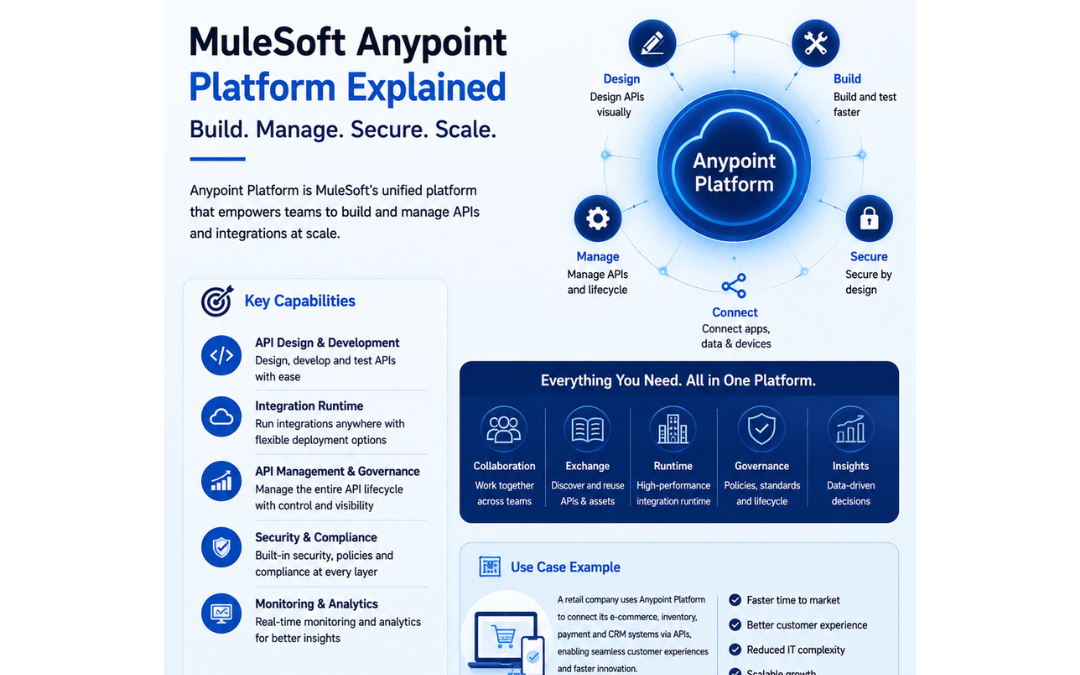
What is MuleSoft?
MuleSoft is a modern enterprise integration platform that uses API-led connectivity to connect systems, applications, and data sources.
MuleSoft helps organizations:
- Build APIs
- Integrate applications
- Automate workflows
- Manage APIs centrally
- Support cloud and hybrid environments
Its Anypoint Platform provides tools for:
- API Development
- Integration
- Deployment
- Monitoring
- Security
- Governance
What is API-Led Integration?
API-led integration is MuleSoft’s modern integration architecture.
Instead of building direct point-to-point connections, MuleSoft creates reusable APIs.
These APIs act as standardized communication layers between systems.
This architecture improves:
- Scalability
- Reusability
- Security
- Flexibility
- Faster development
Three Layers of API-Led Connectivity
1. System APIs
System APIs connect backend systems securely.
Examples:
- SAP
- Salesforce
- Oracle
- Databases
Purpose:
- Retrieve data
- Access backend services
- Hide system complexity
2. Process APIs
Process APIs manage business logic and orchestration.
They:
- Combine data
- Transform information
- Handle workflows
3. Experience APIs
Experience APIs deliver customized data for:
- Mobile applications
- Web portals
- Customer apps
- Partner systems
Each frontend receives optimized data.
Why Businesses Prefer MuleSoft Over Traditional Integration
1. Faster Integration Development
MuleSoft enables reusable APIs and pre-built connectors.
This significantly reduces development time.
Organizations can deliver integrations much faster.
2. Reusable APIs
One of MuleSoft’s biggest advantages is API reusability.
Developers can reuse APIs across multiple applications and projects.
This improves:
- Productivity
- Consistency
- Scalability
3. Better Cloud Connectivity
Modern businesses use:
- AWS
- Salesforce
- Azure
- Google Cloud
- SaaS applications
MuleSoft easily connects cloud and on-premise systems.
Traditional integration struggles with cloud scalability.
4. Improved Scalability
MuleSoft architecture supports enterprise-level scalability.
Organizations can add new applications without rebuilding entire integrations.
5. Centralized API Management
MuleSoft provides centralized API governance.
Businesses can:
- Monitor APIs
- Apply security policies
- Manage access control
- Track API performance
from one platform.
6. Enhanced Security
MuleSoft supports:
- OAuth 2.0
- JWT
- Encryption
- API Policies
- Identity Management
This improves enterprise security significantly.
7. Faster Digital Transformation
MuleSoft accelerates:
- Cloud migration
- Automation
- API modernization
- Enterprise connectivity
Businesses can innovate faster using API-led integration.
Real-Time Example – Traditional Integration vs MuleSoft
Traditional Integration Example
An e-commerce company connects:
- CRM
- ERP
- Payment Gateway
- Mobile App
- Shipping System
using direct connections.
If one system changes:
- Multiple integrations break
- Maintenance becomes difficult
- Development slows down
MuleSoft Integration Example
Using MuleSoft:
- APIs connect systems
- Applications communicate through reusable APIs
- Backend changes do not affect all systems
This improves:
✔ Flexibility
✔ Scalability
✔ Faster deployment
✔ Easier maintenance
Industries Using MuleSoft
MuleSoft is widely used in:
- Banking
- Healthcare
- Retail
- Insurance
- Telecommunications
- Manufacturing
- E-Commerce
These industries require secure and scalable integration platforms.
Benefits of API-Led Integration
API-led integration provides:
- Faster development
- Better agility
- Improved customer experiences
- Simplified architecture
- Easier cloud adoption
- Stronger security
- Reduced operational costs
This is why modern enterprises prefer MuleSoft over traditional integration methods.
Future of Enterprise Integration
The future of enterprise technology is API-driven.
Organizations continue adopting:
- Cloud computing
- Automation
- AI-powered integrations
- SaaS platforms
- Digital ecosystems
Traditional integration models cannot efficiently support these modern demands.
MuleSoft and API-led integration are becoming the preferred enterprise integration standards.
Career Opportunities in MuleSoft
As businesses move away from traditional integration models, demand for MuleSoft professionals is increasing rapidly.
Popular roles include:
- MuleSoft Developer
- Integration Engineer
- API Architect
- Middleware Consultant
- Cloud Integration Specialist
MuleSoft skills are highly valuable in today’s IT industry.
Conclusion
Understanding MuleSoft vs Traditional Integration clearly shows why businesses prefer API-led integration.
Traditional integration methods create:
- Complexity
- Scalability issues
- High maintenance costs
- Slow development
MuleSoft solves these challenges using:
✔ API-led connectivity
✔ Reusable APIs
✔ Cloud integration
✔ Centralized management
✔ Scalable architecture
As enterprises continue investing in digital transformation, MuleSoft will remain one of the leading integration platforms for modern business environments.
Businesses no longer want complicated point-to-point integrations — they need flexible, scalable, and future-ready integration ecosystems powered by APIs.
What is the difference between MuleSoft and traditional integration?
Traditional integration uses direct point-to-point connections, while MuleSoft uses API-led connectivity with reusable APIs and scalable architecture.
Why do businesses prefer MuleSoft?
Businesses prefer MuleSoft because it offers faster development, cloud integration, scalability, centralized API management, and reusable APIs.
What is API-led integration in MuleSoft?
API-led integration is MuleSoft’s architecture approach that organizes integrations into System APIs, Process APIs, and Experience APIs.
Is MuleSoft better for cloud integration?
Yes, MuleSoft supports cloud, on-premise, and hybrid integration environments efficiently.
Which industries use MuleSoft?
Banking, Healthcare, Retail, Telecommunications, Manufacturing, Insurance, and E-Commerce industries widely use MuleSoft.