MuleSoft vs Other Integration Technologies
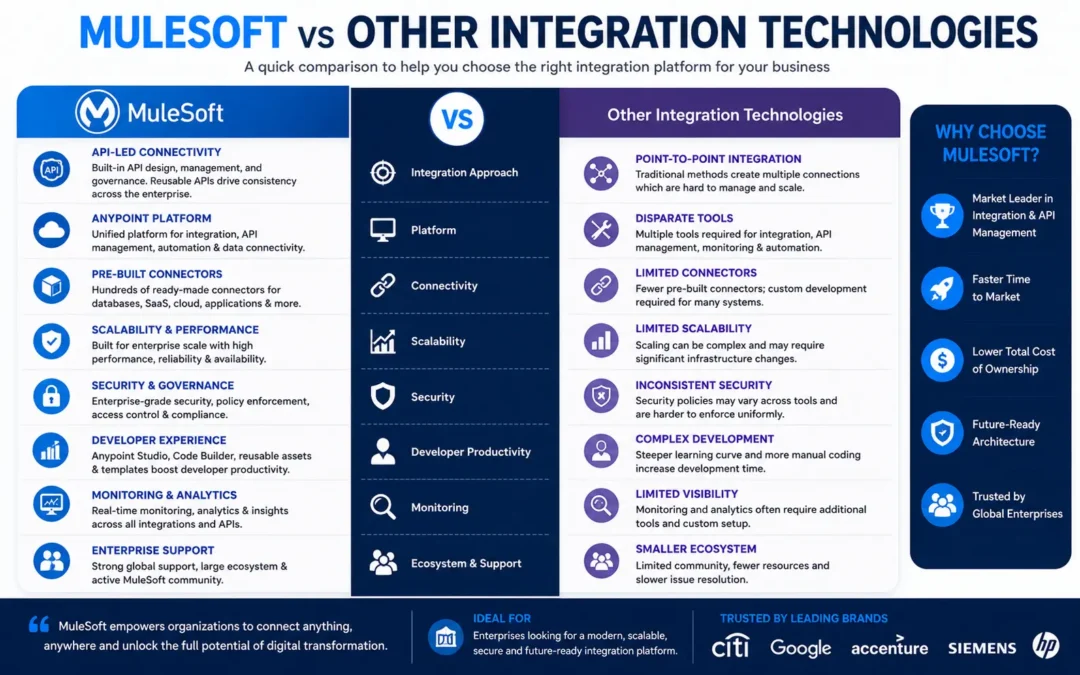
MuleSoft vs Other Integration Technologies: Why Modern Enterprises Choose MuleSoft
Introduction
In today’s digital economy, organizations rely on dozens of applications, databases, cloud services, APIs, and enterprise platforms to manage their operations. Businesses use CRM systems, ERP applications, HR software, payment gateways, customer portals, mobile applications, and cloud platforms to serve customers and streamline internal processes.
The challenge is ensuring all these systems communicate efficiently.
Learn how top enterprises use MuleSoft through hands-on projects in our MuleSoft Training with Real-Time Projects.
This is where enterprise integration becomes critical.
When evaluating integration solutions, one of the most common comparisons organizations make is MuleSoft vs Other Integration Technologies. Businesses want a platform that is scalable, secure, reusable, cloud-ready, and capable of supporting long-term digital transformation initiatives.
Traditional integration methods often struggle with increasing complexity, while MuleSoft provides a modern API-led connectivity approach that simplifies enterprise integration.
This guide explores MuleSoft vs Other Integration Technologies in detail and explains why enterprises worldwide continue choosing MuleSoft as their preferred integration platform.
What is MuleSoft?
MuleSoft is a leading enterprise integration platform that helps organizations connect:
- Applications
- APIs
- Databases
- Cloud Platforms
- Legacy Systems
- SaaS Applications
- Mobile Applications
- IoT Devices
through a unified platform known as the Anypoint Platform.
MuleSoft allows organizations to design, develop, deploy, manage, secure, and monitor APIs and integrations from a centralized environment.
The platform is built around a powerful concept called:
API-Led Connectivity
This architecture enables organizations to create reusable APIs that can be consumed across multiple business applications.
Instead of building the same integrations repeatedly, companies can build once and reuse everywhere.
Why Businesses Compare MuleSoft vs Other Integration Technologies
Enterprise integration has evolved significantly over the last decade.
Organizations previously relied on:
- Point-to-point integrations
- Enterprise Service Buses (ESBs)
- Custom middleware
- Manual file transfers
- Proprietary connectors
While these approaches worked initially, they often created challenges such as:
- High maintenance costs
- Limited scalability
- Complex architectures
- Slow development cycles
- Security concerns
As digital transformation accelerated, businesses needed a more flexible and scalable integration strategy.
This led to the rise of API-led connectivity and platforms like MuleSoft.
Today, MuleSoft vs Other Integration Technologies is an important comparison because organizations want future-ready solutions that support innovation and growth.
MuleSoft vs Other Integration Technologies: Integration Approach
MuleSoft’s API-Led Connectivity
MuleSoft uses a three-layered architecture:
System APIs
These APIs connect directly to backend systems such as:
- SAP
- Oracle
- Salesforce
- Databases
- Legacy Applications
System APIs expose data while hiding system complexity.
Process APIs
Process APIs combine business logic from multiple systems.
Examples include:
- Customer profile aggregation
- Order management workflows
- Payment processing orchestration
Experience APIs
Experience APIs deliver data tailored for specific channels such as:
- Mobile Apps
- Websites
- Partner Portals
- Customer Portals
This architecture promotes reusability and scalability.
Traditional Integration Technologies
Traditional solutions often use direct connections between systems.
For example:
CRM ↔ ERP
ERP ↔ Database
Database ↔ Website
As systems increase, integrations multiply rapidly.
This creates:
- Complex dependencies
- Difficult maintenance
- Reduced agility
Winner: MuleSoft
API-led connectivity provides a cleaner, more scalable architecture that supports enterprise growth.
MuleSoft vs Other Integration Technologies: Platform Capabilities
MuleSoft
The Anypoint Platform combines:
- API Design
- API Development
- Integration Development
- Security
- Monitoring
- Governance
- Analytics
into a single ecosystem.
Organizations manage everything from one platform.
Other Integration Technologies
Many traditional solutions require multiple products for:
- Monitoring
- API Management
- Security
- Integration Development
This increases operational complexity.
Winner: MuleSoft
A unified platform improves productivity and reduces infrastructure overhead.
MuleSoft vs Other Integration Technologies: API Management
Modern enterprises rely heavily on APIs.
MuleSoft provides comprehensive API management features including:
- API Design
- API Documentation
- API Security
- Rate Limiting
- Access Control
- Analytics
- Governance
Traditional integration technologies often lack advanced API management capabilities.
This makes MuleSoft particularly attractive for API-first organizations.
MuleSoft vs Other Integration Technologies: Pre-Built Connectors
One major advantage of MuleSoft is its extensive connector ecosystem.
MuleSoft provides connectors for:
- Salesforce
- SAP
- AWS
- Azure
- Google Cloud
- Oracle
- ServiceNow
- Workday
- Databases
- FTP Servers
- REST APIs
These connectors reduce development effort significantly.
Traditional integration platforms often require custom development.
MuleSoft vs Other Integration Technologies: Scalability
Enterprise systems continuously evolve.
Organizations add:
- New applications
- Cloud services
- Customer channels
- Business processes
A scalable integration platform becomes essential.
MuleSoft Scalability Benefits
✔ Reusable APIs
✔ Cloud-native architecture
✔ Hybrid deployment options
✔ Horizontal scaling
✔ High availability
Traditional integration methods often struggle with enterprise-scale growth.
MuleSoft vs Other Integration Technologies: Security and Governance
Security is a top priority for enterprise organizations.
MuleSoft provides:
- OAuth 2.0
- JWT Authentication
- Encryption
- Access Management
- API Policies
- Governance Controls
This ensures compliance and protects sensitive business data.
Many traditional integration technologies require additional security products and configurations.
MuleSoft vs Other Integration Technologies: Developer Productivity
Developer productivity directly impacts project success.
MuleSoft offers:
- Anypoint Studio
- Drag-and-drop development
- Reusable APIs
- Templates
- DataWeave
- Pre-built connectors
Developers can focus on business logic instead of repetitive coding.
Traditional solutions often involve:
- More custom code
- Manual configurations
- Longer development cycles
MuleSoft vs Other Integration Technologies: Monitoring and Analytics
Enterprise integrations require visibility.
MuleSoft provides:
- Real-time monitoring
- API analytics
- Centralized dashboards
- Alerting
- Performance tracking
Organizations gain complete visibility into their integration landscape.
Traditional platforms frequently require separate monitoring tools.
Why Enterprises Prefer MuleSoft
Organizations choose MuleSoft because it delivers:
Faster Time to Market
Reusable APIs accelerate project delivery.
Improved Agility
Businesses respond faster to changing requirements.
Better Customer Experiences
Connected systems provide real-time information.
Reduced Integration Complexity
API-led architecture simplifies connectivity.
Strong Security
Enterprise-grade controls protect business data.
Cloud Readiness
Supports hybrid and cloud-native environments.
Industries Using MuleSoft
Banking and Financial Services
Used for:
- Payment Processing
- Open Banking APIs
- Customer Onboarding
- Fraud Detection
Healthcare
Used for:
- Electronic Medical Records
- Insurance Processing
- Patient Data Integration
Retail
Used for:
- Inventory Synchronization
- Order Management
- Customer Analytics
Telecommunications
Used for:
- Billing Systems
- Customer Support Platforms
Manufacturing
Used for:
- ERP Integration
- Supply Chain Management
Real Business Benefits of MuleSoft
Organizations implementing MuleSoft often experience:
📈 Faster integration delivery
📈 Reduced maintenance costs
📈 Improved operational efficiency
📈 Better API governance
📈 Enhanced customer experiences
📈 Greater business agility
📈 Accelerated digital transformation
Future of Enterprise Integration
The future of integration is driven by:
- API Economy
- Cloud Computing
- Artificial Intelligence
- Automation
- Microservices
- Digital Ecosystems
Organizations need platforms that support these trends.
MuleSoft is well-positioned to lead the future of enterprise integration.
Why MuleSoft Skills Are in High Demand
The increasing adoption of MuleSoft creates strong career opportunities.
Popular roles include:
- MuleSoft Developer
- API Developer
- Integration Engineer
- MuleSoft Architect
- Middleware Consultant
- Integration Lead
Companies worldwide continue investing in MuleSoft talent.
Conclusion
When comparing MuleSoft vs Other Integration Technologies, MuleSoft consistently emerges as the preferred choice for modern enterprises.
Its API-led connectivity approach, reusable architecture, strong security, cloud readiness, and unified Anypoint Platform make it a powerful solution for enterprise integration.
Businesses seeking to accelerate digital transformation, improve operational efficiency, and future-proof their technology landscape increasingly choose MuleSoft over traditional integration methods.
As APIs, cloud computing, and automation continue driving innovation, MuleSoft will remain a critical technology for organizations worldwide.
FAQs
What is the main difference between MuleSoft and traditional integration technologies?
MuleSoft uses API-led connectivity, while traditional technologies often rely on point-to-point integrations that are harder to scale and maintain.
Why do enterprises prefer MuleSoft?
Enterprises prefer MuleSoft because of its scalability, API management capabilities, security, cloud integration support, and reusable architecture.
Is MuleSoft suitable for cloud integration?
Yes. MuleSoft supports cloud, on-premise, and hybrid integration environments.
Which industries use MuleSoft?
Banking, Healthcare, Retail, Insurance, Manufacturing, Telecommunications, and E-Commerce industries widely use MuleSoft.
Is MuleSoft future-proof?
Yes. MuleSoft aligns with modern technology trends such as APIs, cloud computing, automation, and digital transformation.