
Why MuleSoft Will Dominate the Enterprise Integration Market in 2026
Introduction
The modern business environment is driven by connectivity. Organizations today rely on dozens of applications, cloud platforms, databases, and third-party services to manage their operations. However, when these systems fail to communicate effectively, businesses face delays, inefficiencies, and increased operational costs.
This is where MuleSoft becomes a game-changing technology.
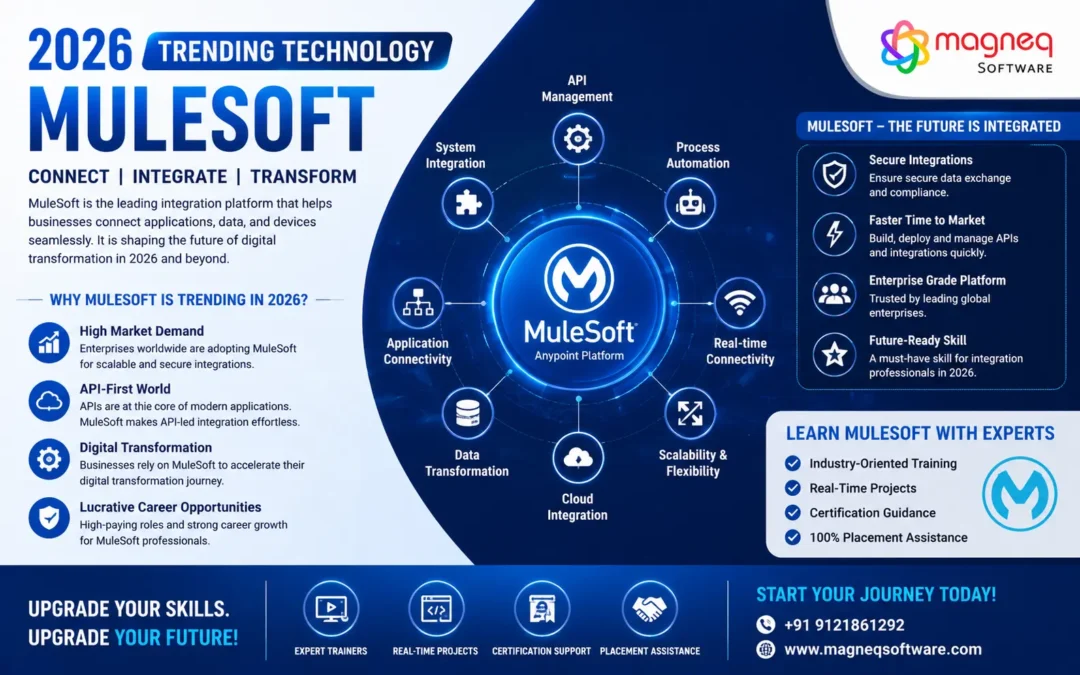
As enterprises accelerate their digital transformation initiatives, MuleSoft has emerged as one of the most in-demand technologies of 2026. Its ability to connect applications, manage APIs, and enable seamless data flow has made it the preferred integration platform for organizations worldwide.
For students, fresh graduates, and IT professionals looking for a future-proof career path, learning MuleSoft can open doors to exciting opportunities in the enterprise integration space.
What is MuleSoft?
MuleSoft is an enterprise integration platform that helps businesses connect applications, systems, and data sources using APIs. Its flagship product, Anypoint Platform, enables organizations to design, build, deploy, secure, and manage APIs and integrations from a single platform.
Rather than creating multiple point-to-point connections, MuleSoft promotes reusable APIs that simplify integrations and improve scalability.
MuleSoft enables organizations to:
- Integrate cloud and on-premise applications
- Create reusable APIs
- Automate business workflows
- Modernize legacy systems
- Improve customer experiences
- Accelerate innovation
Why MuleSoft Is a Trending Technology in 2026
1. The Rise of the API Economy
APIs have become the foundation of digital business. From mobile applications to payment gateways, organizations rely on APIs to deliver connected experiences.
MuleSoft helps enterprises build and manage APIs efficiently, making it a critical technology in today’s API-driven economy.
2. Businesses Need Faster Integration
Modern enterprises use multiple technologies, including CRM systems, ERP applications, cloud platforms, and third-party tools.
Without a proper integration strategy, these systems operate in silos.
MuleSoft enables organizations to:
- Reduce integration complexity
- Improve productivity
- Accelerate development cycles
- Enable faster decision-making
3. Digital Transformation Is Expanding
Organizations are investing heavily in digital initiatives to stay competitive.
Examples include:
- Cloud migration projects
- Customer experience platforms
- Omnichannel services
- Intelligent automation
- Data-driven business models
MuleSoft supports these initiatives by ensuring seamless connectivity between systems.
Understanding API-Led Connectivity
One of MuleSoft’s biggest advantages is its API-led Connectivity approach.
Looking for job-oriented MuleSoft learning? Join our Best MuleSoft Training in Hyderabad and work on real-world integration scenarios.
Instead of creating integrations from scratch every time, MuleSoft structures APIs into reusable layers.
System APIs
These APIs connect directly with backend systems such as databases, ERP applications, and legacy platforms.
Process APIs
They orchestrate and transform data according to business requirements.
Experience APIs
These APIs provide customized experiences for mobile applications, websites, and external partners.
Benefits of API-Led Connectivity
- Faster project delivery
- Increased reusability
- Improved scalability
- Better governance
- Reduced maintenance efforts
Features That Make MuleSoft Popular
Anypoint Platform
A unified integration platform that simplifies API lifecycle management.
Anypoint Studio
A development environment used to build integration applications visually.
DataWeave
MuleSoft’s powerful transformation language for converting and manipulating data.
API Manager
Helps secure, monitor, and govern APIs.
Exchange
A marketplace for reusable connectors, templates, and APIs.
Runtime Manager
Enables deployment and monitoring of Mule applications.
Pre-Built Connectors
MuleSoft offers connectors for popular platforms including:
- Salesforce
- SAP
- Oracle
- Workday
- ServiceNow
- AWS
- Microsoft Dynamics
Benefits of Learning MuleSoft
High Demand in the IT Industry
Organizations are actively searching for professionals with integration expertise.
Strong Salary Growth
Specialized MuleSoft skills often command attractive compensation packages.
Global Career Opportunities
MuleSoft professionals are employed by multinational organizations across various industries.
Exposure to Enterprise Projects
Most MuleSoft implementations involve large-scale enterprise environments.
Future-Proof Technology
As businesses continue adopting cloud and SaaS applications, integration demand will only increase.
Career Opportunities After Learning MuleSoft
Candidates trained in MuleSoft can pursue roles such as:
MuleSoft Developer
Develops APIs and integration solutions.
Integration Developer
Builds connectivity between enterprise applications.
API Developer
Designs and manages secure APIs.
Middleware Engineer
Supports integration platforms and workflows.
MuleSoft Consultant
Provides technical expertise to enterprise clients.
API Architect
Designs enterprise-wide API strategies.
Support Engineer
Monitors and maintains MuleSoft applications.
MuleSoft Salary Trends in 2026
India
- Freshers: ₹5–8 LPA
- 2–5 Years Experience: ₹8–15 LPA
- Senior Professionals: ₹18–30+ LPA
International Markets
- Entry-Level: $70,000–$100,000 annually
- Experienced Professionals: $110,000–$150,000+ annually
Salaries vary depending on certifications, project exposure, and technical expertise.
Who Should Learn MuleSoft?
MuleSoft is suitable for:
- Fresh graduates
- Engineering students
- Java developers
- API developers
- Middleware professionals
- Working IT professionals
- Career switchers interested in integration technologies
Basic understanding of programming concepts and APIs can be beneficial but is not mandatory.
Skills Required to Become a MuleSoft Developer
To succeed in MuleSoft, professionals should develop expertise in:
- Integration concepts
- REST APIs
- SOAP Web Services
- HTTP Protocols
- MuleSoft Anypoint Platform
- Anypoint Studio
- DataWeave
- Connectors
- Error Handling
- API Security
- Deployment Strategies
- Real-Time Project Implementation
Practical experience is often the key differentiator during interviews.
Why Freshers Should Consider MuleSoft
Many freshers compete in highly saturated technologies without exploring specialized domains.
MuleSoft offers unique advantages:
- Lower competition compared to traditional technologies
- Enterprise-level demand
- Faster career progression
- Opportunities in Fortune 500 companies
- Excellent salary potential
- Long-term career stability
With proper training and project exposure, freshers can establish rewarding careers in enterprise integration.
Future Scope of MuleSoft
The future of MuleSoft remains promising because of:
- Growth of the API economy
- Expansion of cloud computing
- Enterprise modernization initiatives
- Increasing SaaS adoption
- Hybrid integration requirements
- Demand for connected customer experiences
- Automation-driven business models
As organizations continue their digital transformation journeys, MuleSoft professionals will remain critical to building and maintaining connected ecosystems.
Conclusion
MuleSoft has evolved into one of the most valuable technologies for modern enterprises. Its ability to simplify integration, enable API-led connectivity, and support digital transformation initiatives makes it one of the top trending technologies in 2026.
For students, freshers, and professionals looking to build a future-ready IT career, MuleSoft offers excellent opportunities, strong earning potential, and exposure to enterprise-level projects.
If you want to become part of the next generation of integration experts, now is the perfect time to start learning MuleSoft.