
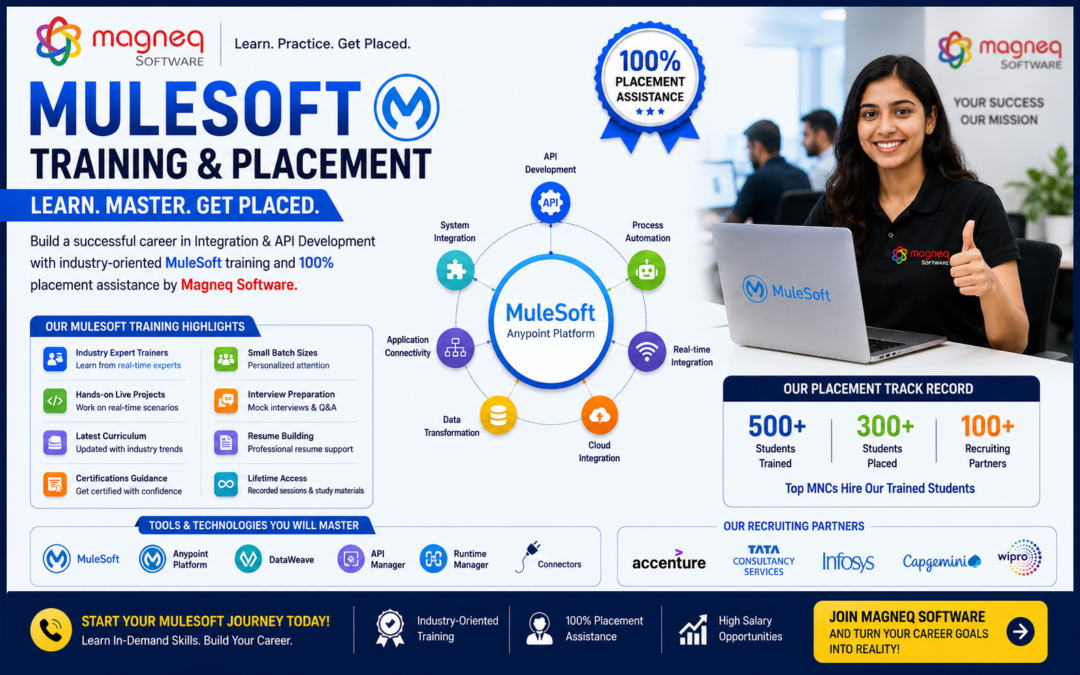
MuleSoft Training and Placement: Your Gateway to a Successful Integration Career in 2026
Introduction
The demand for skilled integration professionals is growing rapidly as organizations continue their digital transformation initiatives. Businesses today rely on multiple applications, cloud platforms, databases, and third-party systems to operate efficiently. Connecting these systems seamlessly has become a critical business requirement, creating a huge demand for MuleSoft professionals worldwide.
MuleSoft has emerged as one of the leading integration platforms, helping enterprises build APIs, connect applications, and automate business processes. As a result, MuleSoft Developers, Integration Engineers, and API Specialists are among the most sought-after IT professionals in 2026.
Master API-led connectivity with expert trainers through our comprehensive MuleSoft Certification Training in Hyderabad.
If you are a student, fresher, or working professional looking to build a rewarding career in enterprise integration, enrolling in a comprehensive MuleSoft training and placement program can be the perfect first step.
In this article, we’ll explore why MuleSoft is a great career choice, what you’ll learn during training, career opportunities, salary trends, and how placement-focused training can help you secure your dream job.
What is MuleSoft?
MuleSoft is a leading integration platform that enables organizations to connect applications, data, and devices through APIs.
Its flagship product, the Anypoint Platform, provides tools for:
- API Design
- API Development
- API Management
- Application Integration
- Data Transformation
- Cloud Integration
Using MuleSoft, businesses can create reusable integrations and accelerate digital transformation initiatives.
Why MuleSoft Is in High Demand in 2026
Modern organizations use multiple systems, including:
- CRM Applications
- ERP Platforms
- Cloud Services
- Databases
- Mobile Applications
- Legacy Systems
Managing communication between these systems is challenging without a robust integration platform.
MuleSoft solves this problem by providing:
✅ API-Led Connectivity
✅ Faster Integration Development
✅ Cloud and On-Premise Connectivity
✅ Reusable APIs
✅ Secure Data Exchange
This growing need for integration has significantly increased the demand for MuleSoft professionals.
Why Choose a Career in MuleSoft?
MuleSoft is considered one of the most promising technologies for IT professionals.
Benefits of a MuleSoft Career
High Demand
Thousands of organizations worldwide are actively hiring MuleSoft Developers.
Attractive Salaries
MuleSoft professionals often receive competitive compensation packages due to the specialized nature of the technology.
Global Opportunities
MuleSoft is used by enterprises across industries and countries.
Diverse Career Paths
Professionals can work as:
- MuleSoft Developer
- Integration Engineer
- API Developer
- Middleware Consultant
- Solutions Architect
- Integration Architect
Future-Proof Technology
As digital transformation continues, integration platforms like MuleSoft will remain essential.
What You’ll Learn in MuleSoft Training
A quality MuleSoft training program covers both foundational and advanced concepts.
Module 1: Integration Fundamentals
- System Integration Basics
- Enterprise Integration Concepts
- SOA vs Microservices
- API Fundamentals
- REST and SOAP Web Services
Why It Matters
Understanding integration fundamentals helps build a strong foundation for MuleSoft development.
Module 2: MuleSoft Platform Overview
- Introduction to MuleSoft
- Anypoint Platform
- Anypoint Studio Setup
- Mule Application Development
Key Outcome
Students become familiar with the MuleSoft ecosystem and development environment.
Module 3: API Development
- REST API Design
- RAML
- API Specifications
- API Security
- API Testing
Industry Relevance
API development is one of the most important skills for MuleSoft professionals.
Module 4: DataWeave
DataWeave is MuleSoft’s powerful data transformation language.
Topics include:
- Data Mapping
- JSON Transformations
- XML Transformations
- CSV Processing
- DataWeave Functions
Why Learn DataWeave?
It is one of the most frequently tested topics in MuleSoft interviews.
Module 5: Connectors and Integration
Students learn to integrate systems using:
- HTTP Connector
- Database Connector
- File Connector
- Salesforce Connector
- FTP Connector
- JMS Connector
Practical Learning
Hands-on exercises help students gain real-world integration experience.
Module 6: Error Handling
Topics include:
- Try Scope
- Error Handling Strategies
- On Error Continue
- On Error Propagate
- Global Error Handling
Error handling is critical for enterprise-grade applications.
Module 7: Deployment and CloudHub
Students learn:
- Application Deployment
- Runtime Manager
- Monitoring
- Logging
- CloudHub Configuration
These skills are highly valued by employers.
Importance of Real-Time Projects
Practical experience is essential for securing a MuleSoft job.
Real-time projects help students:
✔ Understand enterprise scenarios
✔ Improve problem-solving skills
✔ Gain confidence
✔ Build strong resumes
✔ Prepare for interviews
Common Project Examples
- Banking Integration Systems
- E-Commerce Applications
- Healthcare Integrations
- Salesforce Integrations
- Inventory Management Systems
Employers often prioritize candidates with project experience.
Placement Support: The Key to Career Success
Training alone is not enough. Placement assistance plays a major role in helping candidates secure jobs.
A placement-focused MuleSoft training program should include:
Resume Building
Creating industry-standard resumes highlighting technical skills and projects.
Mock Interviews
Preparing students for technical and HR interview rounds.
Technical Assessments
Helping candidates practice interview-level questions.
Soft Skills Training
Improving communication and presentation skills.
Job Referrals
Connecting candidates with hiring companies and recruitment partners.
These services significantly improve placement success rates.
Top MuleSoft Interview Topics
Students preparing for placements should focus on:
MuleSoft Fundamentals
- Mule Events
- Flows and Subflows
- Variables
APIs
- REST APIs
- SOAP APIs
- API-Led Connectivity
DataWeave
- Transformations
- Functions
- Data Mapping
Connectors
- Database Connector
- HTTP Connector
- Salesforce Connector
Error Handling
- Exception Management
- Try Scope
- Error Strategies
Strong preparation in these areas increases interview success.
Career Opportunities After MuleSoft Training
Upon completing training, candidates can apply for roles such as:
MuleSoft Developer
Develop APIs and integrations using MuleSoft.
Integration Engineer
Connect enterprise applications and systems.
API Developer
Design and manage APIs.
Middleware Consultant
Implement enterprise integration solutions.
Solutions Architect
Design scalable integration architectures.
The career path offers continuous growth opportunities.
MuleSoft Salary Trends in 2026
While salaries vary based on location, experience, and skills, MuleSoft professionals generally earn competitive compensation.
Entry-Level Professionals
Freshers with strong project experience and certification often receive attractive offers.
Experienced Professionals
Senior MuleSoft developers and architects command significantly higher salaries due to specialized expertise.
The increasing demand for integration professionals continues to drive salary growth.
Why Choose Magneq Software for MuleSoft Training?
At Magneq Software, students receive:
✅ Industry-Oriented Curriculum
✅ Experienced Trainers
✅ Real-Time Projects
✅ Hands-On Practice
✅ Interview Preparation
✅ Mock Interviews
✅ Resume Assistance
✅ Placement Support
The focus is not only on learning MuleSoft but also on building the skills required to succeed in real-world projects and interviews.
Future of MuleSoft in 2026 and Beyond
Several trends are driving MuleSoft adoption:
API Economy
Organizations continue investing heavily in APIs.
Cloud Computing
Cloud integrations are becoming increasingly important.
Event-Driven Architecture
Real-time integrations are gaining popularity.
Artificial Intelligence
AI-powered systems require seamless connectivity.
Multi-Cloud Environments
Businesses need integration across multiple cloud platforms.
These trends ensure strong demand for MuleSoft professionals for years to come.
Conclusion
MuleSoft has become one of the most valuable technologies in the enterprise integration landscape. As organizations embrace digital transformation, API-led connectivity, and cloud integration, the demand for MuleSoft professionals continues to rise.
A comprehensive MuleSoft training and placement program provides the technical skills, practical experience, and interview preparation needed to build a successful career in integration technology.
Whether you’re a student, fresher, or working professional, investing in MuleSoft training today can open the door to exciting career opportunities and long-term professional growth in 2026 and beyond.
Start your MuleSoft journey today and take the first step toward becoming a highly sought-after integration professional.