
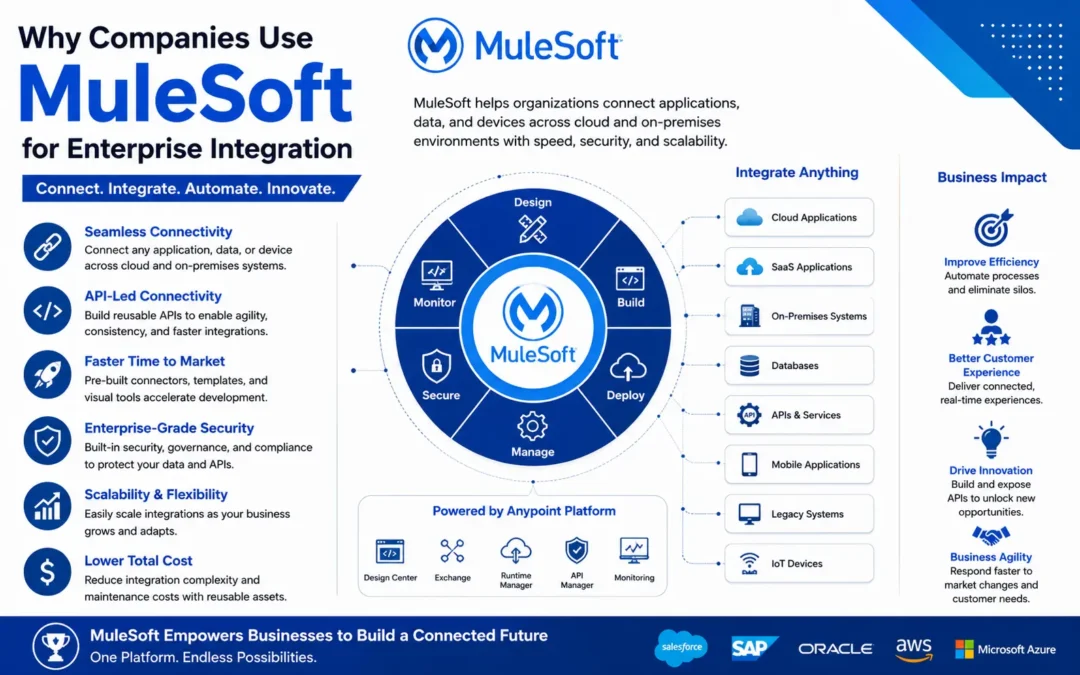
Why Companies Use MuleSoft for Enterprise Integration
Introduction
If you’re looking to build a career in MuleSoft, enrolling in a professional MuleSoft Training Hyderabad program can help you gain practical experience and certification guidance.
In today’s fast-paced digital world, businesses rely on multiple applications, cloud platforms, databases, and third-party systems to manage operations efficiently. From CRM and ERP systems to payment gateways and mobile applications, organizations must ensure all these systems communicate seamlessly.
However, connecting various technologies can become complex, expensive, and difficult to maintain.
This is where MuleSoft plays a crucial role.
Why Companies Use MuleSoft for Enterprise Integration is a common question among organizations seeking scalable and future-ready integration solutions. MuleSoft helps businesses connect applications, data, and devices through APIs, creating a unified and connected digital ecosystem.
By enabling seamless communication between systems, MuleSoft helps organizations improve efficiency, reduce operational costs, and accelerate digital transformation initiatives.
What is MuleSoft?
MuleSoft is a leading enterprise integration and API management platform that enables organizations to connect:
- Applications
- Databases
- Cloud Platforms
- Legacy Systems
- SaaS Applications
- Mobile Apps
- APIs
- IoT Devices
through a unified platform called the Anypoint Platform.
The platform provides tools for:
- API Design
- API Development
- API Management
- Integration Development
- Monitoring
- Security
- Governance
Its mission is simple:
Connect Anything, Anywhere.
This capability makes MuleSoft one of the most valuable integration technologies used by modern enterprises.
Why Enterprise Integration is Important
Businesses today use multiple software systems for different operations.
For example:
- Salesforce for Customer Relationship Management
- SAP for Enterprise Resource Planning
- Workday for Human Resources
- AWS for Cloud Services
- Payment Gateways for Transactions
- Mobile Applications for Customer Engagement
Without integration, these systems often operate independently, resulting in:
❌ Data Silos
❌ Duplicate Information
❌ Manual Processes
❌ Delayed Reporting
❌ Poor Customer Experience
Enterprise integration eliminates these challenges by enabling systems to share information in real time.
Why Companies Use MuleSoft for Enterprise Integration
1. API-Led Connectivity
One of MuleSoft’s biggest strengths is its API-led connectivity approach.
This architecture consists of three layers:
System APIs
System APIs connect backend systems such as:
- SAP
- Oracle
- Salesforce
- Databases
- Legacy Applications
These APIs expose data while hiding backend complexity.
Process APIs
Process APIs combine data from multiple systems and execute business logic.
For example:
A Process API can retrieve customer information from Salesforce and combine it with order details from SAP.
Experience APIs
Experience APIs deliver customized information to:
- Websites
- Mobile Applications
- Customer Portals
- Partner Portals
This approach improves:
✅ Reusability
✅ Scalability
✅ Flexibility
✅ Faster Development
2. Faster Integration Development
Traditional integration methods often require significant coding and maintenance.
MuleSoft simplifies development through:
- Drag-and-Drop Components
- Visual Development Tools
- Pre-Built Templates
- Reusable APIs
- Ready-to-Use Connectors
Developers can build integrations much faster, reducing project timelines and accelerating business initiatives.
3. Extensive Library of Connectors
MuleSoft offers hundreds of pre-built connectors that allow organizations to integrate with popular applications and services.
Examples include:
- Salesforce
- SAP
- Oracle
- AWS
- Microsoft Azure
- Workday
- ServiceNow
- MySQL
- PostgreSQL
- REST APIs
These connectors reduce custom development efforts and improve productivity.
4. Cloud and Hybrid Integration Support
Modern enterprises often operate in hybrid environments.
Some systems run in the cloud, while others remain on-premise.
MuleSoft supports:
Cloud-to-Cloud Integration
Connect cloud applications seamlessly.
Cloud-to-On-Premise Integration
Bridge cloud services with legacy systems.
Hybrid Integration
Manage both cloud and on-premise systems from a unified platform.
This flexibility is one of the key reasons companies use MuleSoft for enterprise integration.
5. Enterprise-Grade Security
Security is critical when handling sensitive business information.
MuleSoft provides advanced security features such as:
- OAuth 2.0
- JWT Authentication
- API Policies
- Encryption
- Access Management
- Threat Protection
These capabilities help organizations maintain compliance and protect valuable data.
6. Better API Management
APIs are the foundation of modern digital business.
MuleSoft enables organizations to:
- Design APIs
- Publish APIs
- Secure APIs
- Monitor APIs
- Govern APIs
through a centralized platform.
This improves API visibility, performance, and control.
7. Improved Scalability
As organizations grow, integration requirements become more complex.
MuleSoft allows businesses to:
- Add new applications
- Expand API ecosystems
- Scale integrations
- Support growing transaction volumes
without redesigning existing integrations.
8. Real-Time Data Connectivity
Modern businesses require real-time information for decision-making.
MuleSoft enables real-time synchronization of:
- Customer Data
- Inventory Information
- Payment Transactions
- Order Status Updates
This improves operational efficiency and customer experiences.
Industries Using MuleSoft
Banking and Financial Services
Banks use MuleSoft for:
- Payment Processing
- Open Banking APIs
- Fraud Detection
- Customer Onboarding
Healthcare
Healthcare organizations use MuleSoft for:
- Electronic Medical Records
- Patient Data Integration
- Insurance Processing
Retail and E-Commerce
Retailers leverage MuleSoft for:
- Inventory Management
- Order Fulfillment
- Customer Analytics
Manufacturing
Manufacturers connect:
- ERP Systems
- Supply Chains
- Production Platforms
using MuleSoft integrations.
Telecommunications
Telecom companies use MuleSoft for:
- Billing Systems
- Customer Service Platforms
- Network Management
Business Benefits of MuleSoft
Faster Time to Market
Reusable APIs accelerate project delivery and innovation.
Reduced Operational Costs
Less custom coding means lower maintenance costs.
Enhanced Customer Experience
Connected systems provide accurate and real-time information.
Better Business Agility
Organizations can respond quickly to changing market conditions.
Improved Productivity
Automation eliminates repetitive manual tasks.
Why MuleSoft is Essential for Digital Transformation
Digital transformation requires businesses to:
- Connect Systems
- Share Data
- Automate Processes
- Deliver Personalized Experiences
MuleSoft acts as the integration layer that enables these initiatives.
By connecting applications and APIs efficiently, MuleSoft helps organizations modernize their technology landscape and achieve digital transformation goals.
Future of MuleSoft
The future of MuleSoft remains strong because of:
Growing API Economy
Organizations increasingly depend on APIs.
Cloud Adoption
Businesses continue migrating to cloud environments.
Artificial Intelligence
AI solutions require connected and accessible data.
Automation
Companies seek greater operational efficiency.
Enterprise Modernization
Legacy systems must connect with modern applications.
These trends ensure long-term demand for MuleSoft technology and professionals.
Conclusion
Understanding Why Companies Use MuleSoft for Enterprise Integration highlights the importance of modern integration platforms in today’s digital economy.
With its API-led connectivity approach, powerful Anypoint Platform, extensive connector ecosystem, enterprise-grade security, and cloud integration capabilities, MuleSoft enables organizations to build scalable and connected digital ecosystems.
As businesses continue embracing cloud technologies, automation, and digital transformation, MuleSoft will remain a critical technology for enterprise integration and innovation.
FAQs
Why do companies use MuleSoft?
Companies use MuleSoft to connect applications, APIs, cloud services, databases, and enterprise systems efficiently through API-led connectivity.
What are the main benefits of MuleSoft?
The main benefits include faster integration, API reusability, scalability, cloud support, security, and improved operational efficiency.
Is MuleSoft only for API management?
No. MuleSoft supports application integration, data integration, cloud integration, API management, and enterprise connectivity.
Which industries use MuleSoft?
Banking, Healthcare, Retail, Telecommunications, Manufacturing, Insurance, and E-Commerce industries widely use MuleSoft.
Is MuleSoft a good technology to learn?
Yes. MuleSoft is highly demanded due to increasing adoption of APIs, cloud computing, automation, and digital transformation initiatives.
#WhyCompaniesUseMuleSoftForEnterpriseIntegration
#MuleSoft
#APIIntegration
#EnterpriseIntegration
#AnypointPlatform
#CloudIntegration
#DigitalTransformation
#APIManagement
#MuleSoftDeveloper
#Automation
#CloudComputing
#BusinessTransformation
#ConnectedSystems
#EnterpriseArchitecture
#MuleSoftTraining