MuleSoft Course with Placement – Start Your Career in Enterprise Integration
The demand for skilled integration professionals is increasing as organizations continue to adopt cloud computing, digital transformation, and API-led connectivity. Businesses today rely on multiple software applications, cloud platforms, databases, and third-party services to manage their operations. Ensuring seamless communication between these systems has become essential, creating a strong demand for professionals who specialize in enterprise integration.
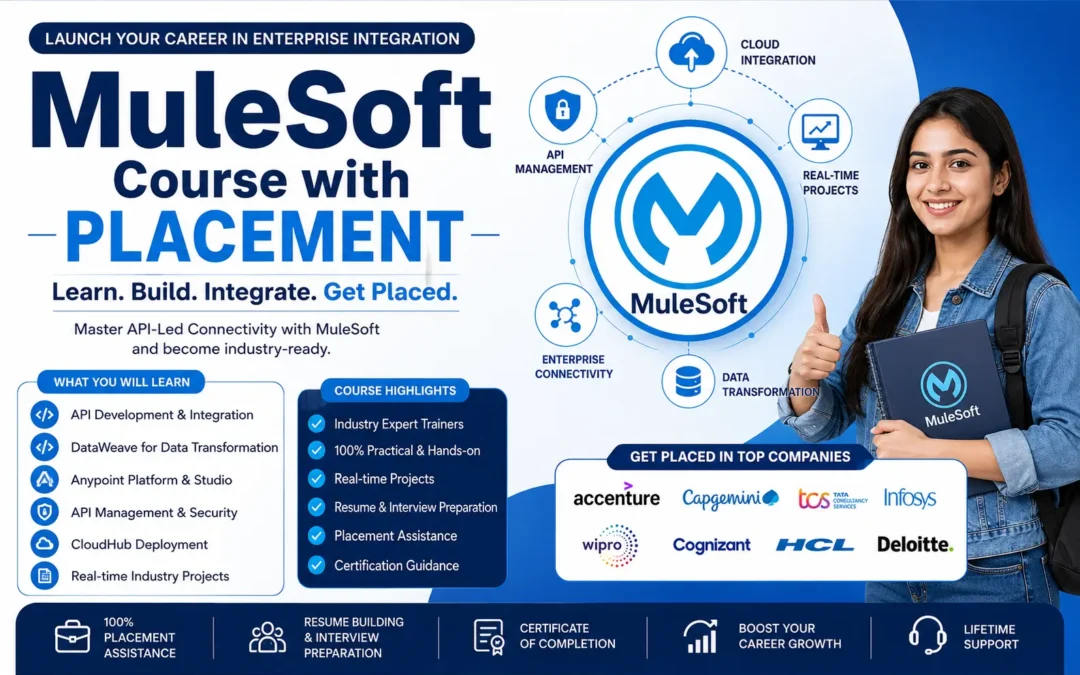
A MuleSoft Course with Placement is designed to help learners acquire the practical skills required to build, deploy, and manage APIs while gaining real-world experience through hands-on projects. Whether you are a fresher looking for your first IT job, a software developer planning to upskill, or a working professional seeking career growth, MuleSoft offers outstanding opportunities in one of the fastest-growing areas of enterprise technology.
Unlike many traditional programming courses, MuleSoft training focuses on solving real business challenges. Instead of building standalone applications, developers learn how to integrate multiple enterprise systems, automate workflows, and create reusable APIs that improve business efficiency. These are the exact skills that modern organizations are looking for when hiring integration professionals.
What is MuleSoft?
MuleSoft is a leading enterprise integration platform that enables organizations to connect applications, systems, databases, and cloud services using APIs. Rather than creating separate integrations for every application, MuleSoft provides a unified platform that simplifies communication between different technologies.
The core of MuleSoft is the Anypoint Platform, which allows developers to design, develop, deploy, monitor, and manage APIs from a single environment. This platform is widely used by organizations to accelerate digital transformation initiatives and improve operational efficiency.
The MuleSoft ecosystem includes several powerful components:
- Anypoint Studio
- API Manager
- Runtime Manager
- Exchange
- CloudHub
- DataWeave
- Mule Runtime
These tools enable developers to build secure, scalable, and reusable integration solutions for enterprise applications.
Why is MuleSoft in High Demand?
The IT industry is moving toward API-first architectures, cloud-native applications, and microservices. Organizations no longer rely on a single software application. Instead, they use CRM systems, ERP solutions, cloud platforms, payment gateways, analytics tools, and customer portals that need to exchange information in real time.
MuleSoft simplifies these complex integrations, making it one of the most valuable technologies for enterprise application development.
Several factors contribute to the growing demand for MuleSoft professionals:
- Rapid adoption of cloud computing
- API-led digital transformation
- Enterprise modernization projects
- Increasing use of SaaS applications
- Real-time data synchronization
- Automation of business processes
- AI-powered enterprise solutions
As a result, companies are actively hiring MuleSoft Developers, Integration Engineers, API Specialists, and Solution Architects.
Why Choose a MuleSoft Course with Placement?
Learning a technology is only the first step. Securing a job requires practical experience, confidence, and interview preparation. A placement-focused MuleSoft course combines technical training with career support to help learners become industry-ready.
Industry-Oriented Curriculum
The curriculum is designed according to current enterprise requirements, covering everything from API fundamentals to advanced integration techniques. Learners gain exposure to REST APIs, SOAP services, DataWeave transformations, API management, CloudHub deployment, security policies, and CI/CD practices.
Hands-On Practical Sessions
Practical implementation plays a key role in mastering MuleSoft. Learners work on coding exercises, API integrations, cloud deployments, and enterprise use cases instead of focusing only on theoretical concepts.
Real-Time Industry Projects
Working on real-world integration projects helps students understand enterprise workflows and prepares them for the challenges faced in professional environments. These projects simulate scenarios commonly found in banking, healthcare, retail, insurance, logistics, and manufacturing.
Placement Assistance
Placement support typically includes:
- Resume preparation
- LinkedIn profile optimization
- Mock technical interviews
- HR interview guidance
- Aptitude preparation
- Career counseling
- Job referral assistance
These services help improve employability and boost confidence during the recruitment process.
Skills You Will Learn
A comprehensive MuleSoft course equips learners with the technical and practical skills needed to work on enterprise integration projects.
Some of the major skills covered include:
- API Development
- REST and SOAP Web Services
- API-Led Connectivity
- Mule Flows and Subflows
- DataWeave Transformations
- JSON and XML Processing
- Database Connectivity
- CloudHub Deployment
- API Security
- Error Handling
- Batch Processing
- Salesforce Integration
- AWS and Azure Integration
- Git Version Control
- CI/CD Pipelines
- API Monitoring
These skills prepare learners for a wide range of integration roles across different industries.
Who Can Join a MuleSoft Course?
One of the biggest advantages of MuleSoft training is that it is suitable for learners from different backgrounds.
Fresh Graduates
Students who have recently completed their degree can build a strong foundation in enterprise integration and improve their employability.
Working Professionals
Developers, testers, support engineers, and system administrators can enhance their technical expertise by learning MuleSoft.
Career Switchers
Individuals looking to transition into software development or enterprise integration can benefit from structured MuleSoft training.
Software Developers
Java, .NET, Python, and Full Stack Developers can expand their skill set by mastering API development and enterprise integrations.
No prior MuleSoft experience is required. Basic programming knowledge and an interest in learning integration technologies are sufficient to get started.
Why Practical Training Matters
Employers value candidates who can demonstrate real-world problem-solving abilities. Practical MuleSoft training enables learners to apply theoretical concepts to business scenarios, making them job-ready.
Hands-on learning helps students understand API design, integration patterns, cloud deployment, data transformation, and enterprise workflows. This practical exposure significantly improves confidence during technical interviews and prepares learners to contribute effectively from day one in a professional environment.