
The demand for AWS DevOps professionals continues to grow as organizations adopt cloud computing and automation to deliver applications faster and more reliably. Whether you’re a student, software developer, system administrator, or IT professional looking to transition into cloud technologies, following a well-structured AWS DevOps Roadmap can help you build the right skills and achieve your career goals.
This AWS DevOps Roadmap outlines the essential skills, tools, and technologies you need to master, from cloud fundamentals to advanced DevOps practices. By following this roadmap, you can confidently prepare for real-world AWS DevOps roles and stay competitive in today’s cloud-driven IT industry.
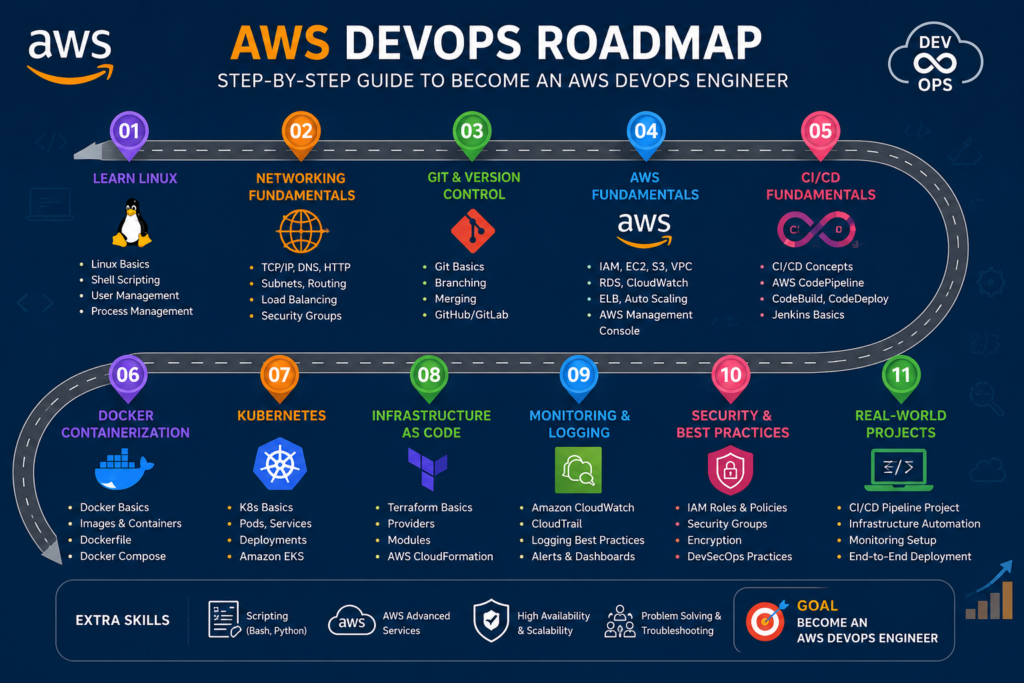
What Is AWS DevOps?
AWS DevOps combines software development (Dev) and IT operations (Ops) using Amazon Web Services (AWS). The goal is to automate software development, testing, deployment, monitoring, and infrastructure management to deliver applications efficiently and reliably.
Following an AWS DevOps Roadmap helps you understand how AWS services integrate with DevOps tools to automate workflows, improve collaboration, and accelerate software delivery.
Why Learn AWS DevOps?
AWS remains one of the most widely used cloud platforms across industries. Organizations rely on AWS DevOps engineers to automate infrastructure, build CI/CD pipelines, manage cloud environments, and ensure application reliability.
By following an AWS DevOps Roadmap, you can:
- Build practical cloud engineering skills
- Automate deployment workflows
- Improve software delivery processes
- Work with modern DevOps tools
- Prepare for high-demand cloud careers
- Gain hands-on experience with AWS services
Step 1: Learn Linux Fundamentals
The first step in the AWS DevOps Roadmap is mastering Linux, as it is the foundation of many cloud environments.
Learn the following:
- File system navigation
- User and permission management
- Shell commands
- Package management
- Process monitoring
- Bash scripting
Strong Linux skills make it easier to manage cloud servers, automate administrative tasks, and troubleshoot issues efficiently.
Step 2: Understand Networking Basics
Networking knowledge is essential for every AWS DevOps Engineer.
Your AWS DevOps Roadmap should include learning:
- IP Addressing
- DNS
- HTTP & HTTPS
- Load Balancers
- Firewalls
- Subnets
- Routing
- VPN Concepts
These networking fundamentals help you build secure, scalable, and highly available AWS environments.
Step 3: Learn Git and Version Control
Version control enables development teams to collaborate efficiently and maintain code quality.
Practice:
- Creating repositories
- Branching strategies
- Pull requests
- Merging changes
- Resolving conflicts
GitHub and GitLab are widely used platforms that play a crucial role in every AWS DevOps Roadmap.
Step 4: Build a Strong AWS Foundation
Before learning advanced DevOps tools, build a solid understanding of AWS cloud services.
Important services include:
- Amazon EC2
- Amazon S3
- Amazon VPC
- AWS IAM
- Amazon RDS
- Elastic Load Balancer
- Auto Scaling
- Amazon CloudWatch
Hands-on practice with these services is one of the most important milestones in your AWS DevOps Roadmap.
Step 5: Learn CI/CD Concepts
Continuous Integration (CI) and Continuous Delivery (CD) automate software delivery and improve development efficiency.
Key concepts include:
- Automated Builds
- Continuous Testing
- Deployment Pipelines
- Release Automation
Popular AWS services include:
- AWS CodePipeline
- AWS CodeBuild
- AWS CodeDeploy
- AWS CodeCommit
Many organizations also use Jenkins and GitHub Actions alongside AWS services.
Step 6: Learn Docker
Docker packages applications into portable containers, making deployments faster and more consistent.
Important topics include:
- Docker Images
- Containers
- Dockerfiles
- Docker Compose
- Container Networking
- Volumes
Containerization is an essential skill covered in every modern AWS DevOps Roadmap.
Step 7: Learn Kubernetes
Kubernetes helps manage containerized applications at scale.
Start by learning:
- Pods
- Deployments
- Services
- ReplicaSets
- Namespaces
- Ingress
You can then explore Amazon Elastic Kubernetes Service (Amazon EKS) to deploy and manage Kubernetes clusters on AWS.
Step 8: Learn Infrastructure as Code (IaC)
Infrastructure as Code allows cloud infrastructure to be created and managed using code.
Popular tools include:
- Terraform
- AWS CloudFormation
Learning Infrastructure as Code enables automation, consistency, scalability, and version-controlled infrastructure deployment, making it a critical stage of the AWS DevOps Roadmap.
Step 9: Monitoring and Logging
Reliable applications require continuous monitoring.
Popular monitoring solutions include:
- Amazon CloudWatch
- AWS CloudTrail
- Prometheus
- Grafana
Monitoring helps identify issues early, improve application performance, and maintain system reliability.
Step 10: Learn Security Best Practices
Security is an integral part of every DevOps workflow.
Focus on:
- IAM Roles and Policies
- Multi-Factor Authentication (MFA)
- Security Groups
- Encryption
- Secrets Management
- Compliance Best Practices
Integrating security throughout the software development lifecycle is commonly known as DevSecOps.
Build Hands-On Projects
Practical experience is one of the most valuable parts of an AWS DevOps Roadmap.
Build projects such as:
- CI/CD Pipeline for a Web Application
- Infrastructure Provisioning with Terraform
- Dockerized Application Deployment on AWS
- Kubernetes Deployment using Amazon EKS
- Monitoring Dashboard with CloudWatch and Grafana
Real-world projects demonstrate your skills and strengthen your professional portfolio.
Career Opportunities After Following the AWS DevOps Roadmap
Completing an AWS DevOps Roadmap prepares you for exciting career opportunities, including:
- AWS DevOps Engineer
- Cloud Engineer
- Site Reliability Engineer (SRE)
- Platform Engineer
- Infrastructure Engineer
- Cloud Operations Engineer
Professionals with AWS DevOps expertise are in high demand across industries such as IT services, finance, healthcare, e-commerce, and startups.
Final Thoughts
Following a structured AWS DevOps Roadmap is one of the best ways to build a successful career in cloud computing and automation. Start by learning Linux, networking, Git, and AWS fundamentals before progressing to Docker, Kubernetes, Terraform, CI/CD, monitoring, and security.
Consistent practice, hands-on projects, and continuous learning will help you become job-ready and confident in managing modern cloud infrastructure. Whether you’re a beginner or an experienced IT professional, this AWS DevOps Roadmap provides a clear learning path to becoming a skilled AWS DevOps Engineer and achieving long-term career growth.