
Cloud computing has transformed how businesses develop, deploy, and manage applications. As organizations increasingly adopt cloud platforms, the demand for skilled AWS DevOps professionals continues to grow. If you’re exploring a career in cloud computing or software development, you may be wondering: What is AWS DevOps Training?
AWS DevOps Training is a structured learning program that teaches you how to use Amazon Web Services (AWS) along with DevOps practices to automate software development, testing, deployment, and infrastructure management. Whether you are a student, software developer, system administrator, or IT professional, AWS DevOps training can help you build in-demand cloud skills and prepare for rewarding career opportunities.
In this guide, you’ll learn what AWS DevOps Training is, why it’s important, what you’ll learn, career opportunities, and how to get started.
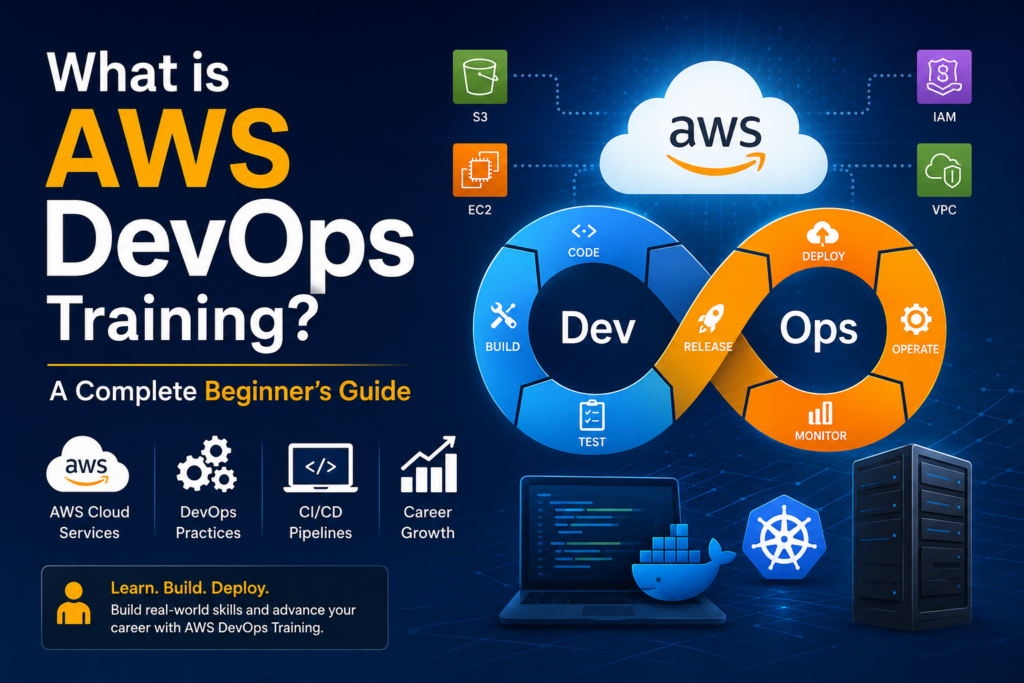
What is AWS DevOps Training?
AWS DevOps Training is a professional training program designed to teach learners how to combine AWS cloud services with DevOps principles. It focuses on automating software delivery, managing cloud infrastructure, implementing Continuous Integration and Continuous Deployment (CI/CD), monitoring applications, and improving collaboration between development and operations teams.
The training covers both theoretical concepts and practical implementation using real-world AWS services and DevOps tools.
By completing AWS DevOps Training, learners gain hands-on experience in building, deploying, monitoring, and maintaining cloud-based applications efficiently.
Understanding DevOps
Before learning AWS DevOps, it’s important to understand DevOps itself.
DevOps is a culture and methodology that encourages collaboration between software developers and IT operations teams. Instead of working separately, both teams work together throughout the software development lifecycle.
The primary goals of DevOps include:
- Faster software delivery
- Improved software quality
- Automated deployments
- Reduced downtime
- Better collaboration
- Continuous improvement
Why AWS for DevOps?
Amazon Web Services (AWS) is one of the world’s leading cloud computing platforms. It offers hundreds of cloud services that simplify infrastructure management, application deployment, monitoring, and automation.
AWS provides services specifically designed for DevOps workflows, making it an ideal platform for learning and implementing DevOps practices.
Some benefits of using AWS for DevOps include:
- Scalable cloud infrastructure
- High availability
- Secure deployments
- Pay-as-you-go pricing
- Extensive automation capabilities
- Global data centers
What Will You Learn in AWS DevOps Training?
A comprehensive AWS DevOps Training program typically covers the following topics.
1. Cloud Computing Fundamentals
You’ll understand:
- Cloud concepts
- Types of cloud services
- AWS Global Infrastructure
- Regions and Availability Zones
2. Linux Administration
Linux is widely used in cloud environments.
Topics include:
- Linux commands
- User management
- File permissions
- Package installation
- Shell scripting
3. Version Control with Git
Git allows developers to manage source code efficiently.
You’ll learn:
- Git basics
- Branching
- Merging
- GitHub repositories
- Collaboration workflows
4. Continuous Integration (CI)
Continuous Integration helps developers merge code frequently while automatically testing every change.
Popular tools include:
- Jenkins
- AWS CodeBuild
- GitHub Actions
5. Continuous Deployment (CD)
Continuous Deployment automates software releases.
Topics include:
- AWS CodeDeploy
- AWS CodePipeline
- Automated deployment strategies
- Rollback mechanisms
6. Infrastructure as Code (IaC)
Infrastructure can be managed using code rather than manual configuration.
You’ll learn:
- AWS CloudFormation
- Terraform basics
- Infrastructure automation
7. Docker Containers
Containers package applications with all dependencies.
Training includes:
- Docker installation
- Docker images
- Docker containers
- Docker Compose
8. Kubernetes
Container orchestration is an essential DevOps skill.
Topics include:
- Kubernetes architecture
- Pods
- Services
- Deployments
- Amazon EKS
9. Monitoring and Logging
Application monitoring helps maintain performance and availability.
You’ll learn:
- Amazon CloudWatch
- AWS CloudTrail
- Log management
- Alerts and dashboards
10. Security Best Practices
Security is an important part of DevOps.
Topics include:
- IAM (Identity and Access Management)
- Multi-Factor Authentication
- Security Groups
- AWS Secrets Manager
- Encryption
AWS Services Covered in AWS DevOps Training
A quality AWS DevOps course usually includes:
- Amazon EC2
- Amazon S3
- AWS IAM
- AWS VPC
- Elastic Load Balancer
- Auto Scaling
- Amazon RDS
- AWS Lambda
- Amazon CloudWatch
- AWS CloudFormation
- AWS CodePipeline
- AWS CodeDeploy
- AWS CodeCommit
- AWS CodeBuild
- Amazon EKS
- Amazon ECS
Who Should Learn AWS DevOps?
AWS DevOps Training is suitable for:
- Engineering students
- Computer science graduates
- Software developers
- System administrators
- Network engineers
- Cloud engineers
- DevOps beginners
- IT professionals looking to switch careers
- Professionals preparing for AWS certifications
No advanced programming experience is required, although basic knowledge of Linux and networking is beneficial.
Benefits of AWS DevOps Training
Learning AWS DevOps offers several advantages:
High Industry Demand
Organizations worldwide are adopting cloud technologies, creating strong demand for AWS DevOps professionals.
Better Career Opportunities
AWS DevOps skills can open roles such as:
- AWS DevOps Engineer
- Cloud Engineer
- Site Reliability Engineer (SRE)
- Build and Release Engineer
- Cloud Consultant
- Platform Engineer
Higher Salary Potential
Professionals with AWS and DevOps expertise are often among the highest-paid in the IT industry due to their specialized skills.
Practical Skills
Most AWS DevOps Training programs emphasize hands-on labs, enabling learners to gain real-world experience with cloud infrastructure and deployment pipelines.
AWS DevOps Career Path
A typical career progression may look like this:
- Learn Linux and Networking
- Master AWS Cloud Fundamentals
- Learn Git and GitHub
- Understand CI/CD Pipelines
- Learn Docker
- Learn Kubernetes
- Study Terraform or CloudFormation
- Practice Monitoring Tools
- Work on Real-Time Projects
- Earn AWS Certifications
Frequently Asked Questions (FAQs)
What is AWS DevOps Training?
AWS DevOps Training teaches you how to use AWS cloud services and DevOps practices to automate software development, testing, deployment, monitoring, and infrastructure management.
Is AWS DevOps suitable for beginners?
Yes. Beginners with basic computer knowledge and an interest in cloud technologies can start learning AWS DevOps. Familiarity with Linux and networking is helpful but not mandatory.
How long does it take to learn AWS DevOps?
With consistent study and hands-on practice, most learners can build a solid foundation in 4–6 months. Becoming job-ready often depends on the depth of practical experience and project work.
What is the salary of an AWS DevOps Engineer?
Salaries vary by country, experience, and employer. AWS DevOps Engineers are generally well-compensated due to the growing demand for cloud and automation expertise.
Do I need coding skills for AWS DevOps?
Basic scripting knowledge (such as Bash or Python) is beneficial, but many AWS DevOps concepts can be learned without extensive programming experience.
Conclusion
If you’ve been asking, “What is AWS DevOps Training?”, the answer is simple: it’s a practical pathway to learning how cloud computing and DevOps work together to build, deploy, and manage modern applications efficiently.
By gaining expertise in AWS services, automation tools, CI/CD pipelines, containers, and infrastructure management, you’ll be well-prepared for a wide range of cloud careers. Whether you’re a student beginning your IT journey or an experienced professional looking to upskill, AWS DevOps Training provides valuable, industry-relevant knowledge that can help you grow in today’s technology landscape.
Start with the fundamentals, practice consistently, build real-world projects, and keep learning—the cloud industry continues to offer exciting opportunities for those with strong AWS DevOps skills.